
Belated happy new year! I wrote this post while waiting for a delayed flight back to the Netherlands over a month ago, but never got around to uploading it. After clawing my way out of the gluttonous vortex that is the week between Christmas and New Year’s Eve, I found myself in a bit of a reflective mood. 2023 was a year full of personal changes and transitions (a new job, among others), and I have much to be grateful for. It has also been a turbulent year for humanity, with climate change rearing its ugly head in new and worrying ways, and growing conflicts around the world, especially in the Gaza and the Ukraine.
However, a dependable constant through these many changes has been a steady diet of books. After sharing my favourite books of 2022, I thought I would do the same again this year. Again, they are presented in more or less the order that I read them, and they include books that devoured my attention, changed my perspective, or just made me laugh. None of these books have anything to do with coastal engineering and most are fiction, but I am a firm believer that reading widely is good for your research and more importantly for the soul. Hopefully you find something here that sparks your curiosity- let me know what you think if you read any of them!
George Saunders – Liberation Day and other short story collections
This was my year of George Saunders! I was a little late to the party, as Saunders has already been scooping up award after award for years. I read Lincoln in the Bardo last year and found it odd but moving. However, last Christmas I picked up his newest short story collection, Liberation Day, and was blown away, particularly the story Love Letter, advice given by a grandfather to his son in politically worrying times that seem frighteningly plausible given recent political shifts around the world. His reading of Love Letter (here) is understated but powerful.
Eagerly hoovering up anything of his that I could find, I also chewed through his short story collections Tenth of December, Pastoralia, and CivilWarLand in Bad Decline, and although weird and well-done, I didn’t enjoy them as much. Nonetheless, he almost always seems to swoop in at the end with a beautiful thought about life or humanity. The titular story in Tenth of December was really moving.
Saunders’ Fox 8 is just a short novella about a fox, it is written from the perspective of a fox with terrible (or remarkable, depending on how you look at it) spelling, very phonetic and childish but with a mature outlook on the world. This is a prime example of needing to know all the rules before you can start to break them – it takes a brilliant writer to write so childishly. It tells a compelling environmental story and makes you reflect on why people (“Yumans”, in foxspeak) can be so lousy, but also give hope for the world.

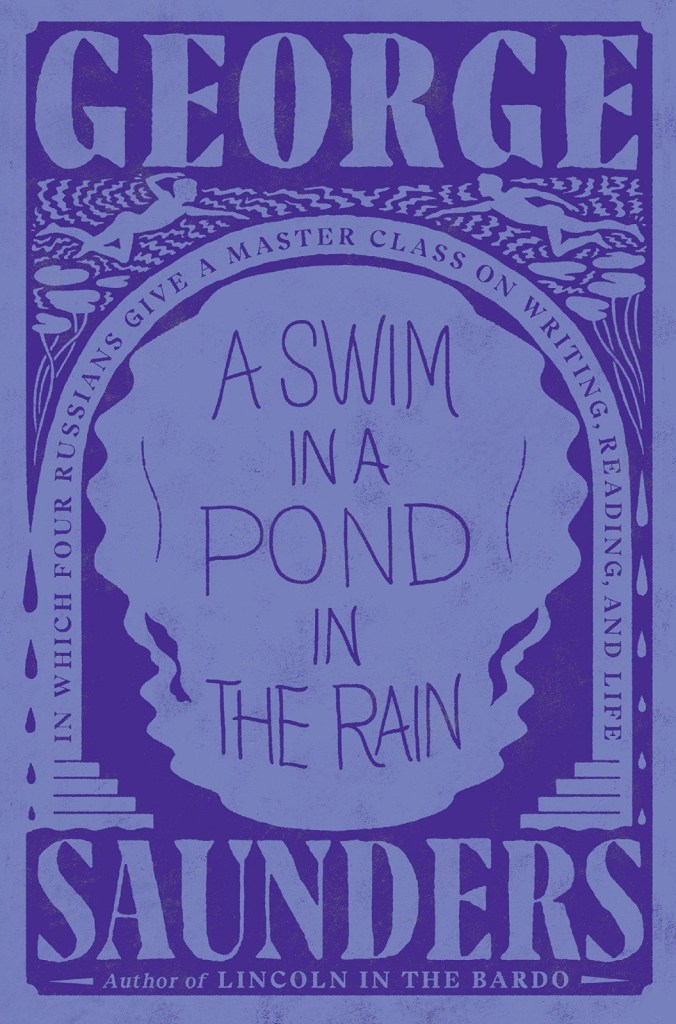
George Saunders – A Swim in a Pond in the Rain
My favourite book of 2023 was also by George Saunders, but it did not include his own stories. When he is not busy writing, Saunders teaches creative writing at the University of Syracuse, and annually teaches a class on Russian short stories. In this book, he compiled his course notes (along with the stories), and it is a compelling dissection of how to tell a story. A Swim in a Pond in the Rain might not be everyone’s cup of tea, but if you enjoy writing and thinking about writing and love short stories, maybe it will resonate with you too.
It is a fascinating exploration of Russian short stories and life, from one of my new favourite authors. George Saunders, for all his own weird prose quirks, is someone I feel a strong sense of writerly/readerly kinship (maybe it’s because he used to be a geological engineer before he pursued writing full-time), and the depth of his empathy and understanding for the human condition really comes through here. This book makes me want to write fiction and is much more inspiring than the other writing books I’ve read this year (e.g., by Kurt Vonnegut and Haruki Murakami). I have been drawn in by his empathy, the way he talks about being human and choosing kindness when navigating our crazy world. Something to aspire to.
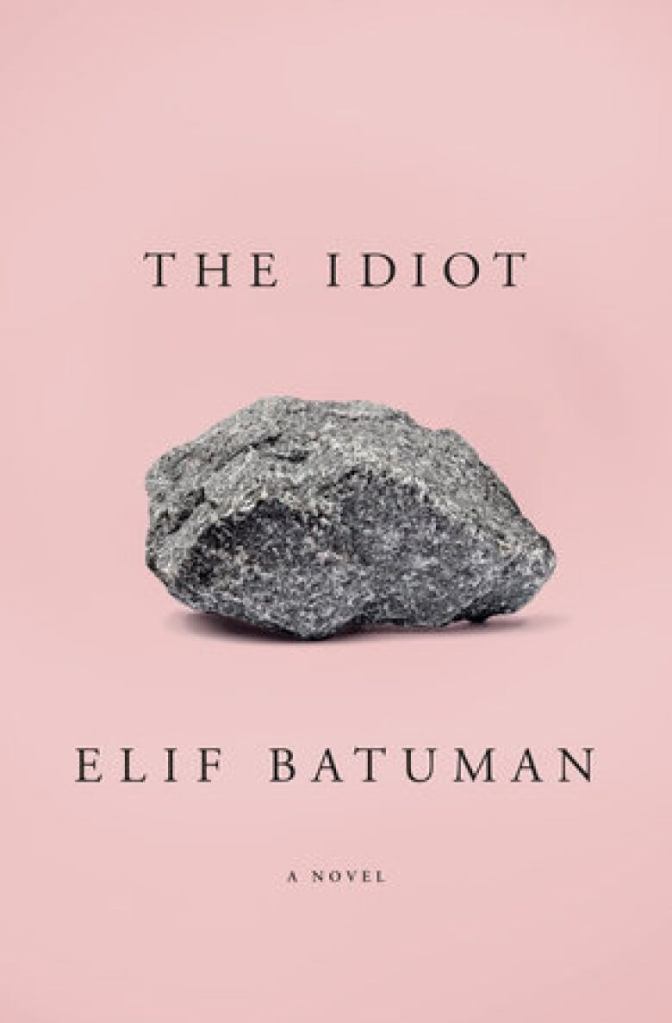
Elif Batuman – The Idiot and Either/Or
The Idiot (à la Dostoyevsky or perhaps Iggy Pop?) gave me an extreme case of sentence envy – there were many moments when I found myself wishing I could write like Elif Batuman. As a perennial Peter Pan who is determined to stay in school forever, I love a good campus novel, so this one scratched all the right itches. Although it loses a bit of momentum in the second half, the first part of the book (following a Harvard student of Russian literature) was fantastic. The sequel, Either/Or, had more beautiful sentences galore, but also suffered from the same problem as its predecessor, lacking a bit of a narrative arc in the second half. But the main character and the quality of the writing made both well worth reading.
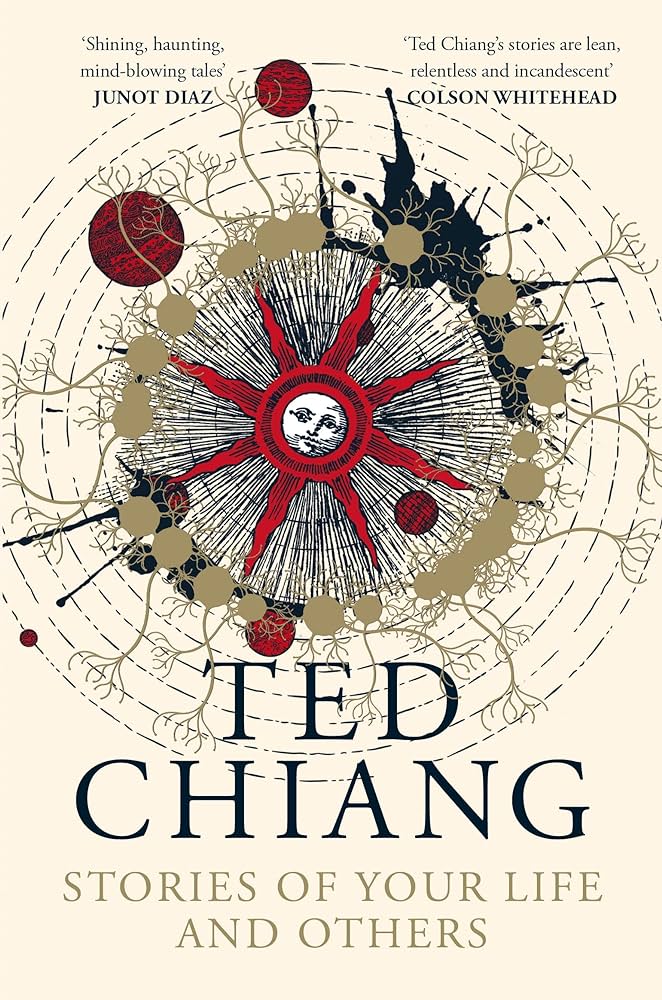
Ted Chiang – Stories of Your Life and Exhalation
One of the most delightful discoveries that one can make (and one that you will find I made repeatedly this year) is that the author of the book you just finished and adored has piles of other stories waiting for you. This is where online shopping becomes problematic because their entire bibliography is then just one click away.
Ted Chiang has written a collection of powerful and poignant science fiction stories, my favourite being the titular Story of Your Life, upon which the movie Arrival was later based. There are a few less-stellar stories too, but it was probably the best science fiction I’ve read since Three Body Problem (with a hint of Contact).
I borrowed Ted Chiang’s second collection, Exhalation from my friend Claudia almost immediately after reading Stories of Your Life. The first two stories, The Merchant and the Alchemist’s Gate and Exhalation were powerful, but I think my favourite was the final story, Anxiety Is the Dizziness of Freedom, which explored all kinds of compelling ethical questions surrounding branching realities in parallel universes, something that I had previously contemplated but never so eloquently. What fantastic ideas Ted Chiang has.
Ali Smith – Spring
After reading Ali Smith’s Autumn last year, I became determined to read the other three books in her seasonal quartet during the appropriate season. Though Winter was a bit scattered in terms of plot, the writing was beautiful and it still managed to really capture the feeling of post-Brexit Britain. Spring was probably my favourite book of Ali Smith’s yet. It is poetic, moving, very much of its times (with some pointed criticism of the way society treats its most vulnerable), and there are a few passages where she talks about the Gaelic language that really pull at something in me. Summer ended up being my least favourite of the four books, but that was partly my own fault- I didn’t think the books needed to be read together, but then many of the characters came back in this one, so I think I missed some connections. Summer was also the first pandemic-era novel that I’ve read, which made it a little unsettling. I think it’s still a bit early for me to willingly revisit that…

Phillip Pullman – His Dark Materials Trilogy
Phillip Pullman’s The Golden Compass has been one of my all-time favourite books since I first read it in elementary school, and it holds up surprisingly well. The story is action-packed and compelling, and this time around I noticed even more clever historical or geographic details in the world Phillip Pullman built, which I never picked up on as a kid (particularly after having lived in Norway and the UK). The second book in the His Dark Materials series, The Subtle Knife, is not as good as the other two, but still a classic. I loved the concept of hopping between parallel worlds. The final book in the His Dark Materials series, The Amber Spyglass, explores so many cool ideas and concepts that were quite bold for my then-11-year-old brain, and is so beautifully expressed at times. Still one of my all-time favourites.

Jeff Lemire – Essex County
Graphic novel exploring life in Essex County, Ontario, not far from where I grew up. It is a bit more rural and hockey-centric than my own experiences growing up, but I really liked the way the characters leapt off the page and how he managed to evoke the feeling of the landscape and farms. I never knew that I would crave nostalgia of driving around in Southwestern Ontario but this book gave it to me.

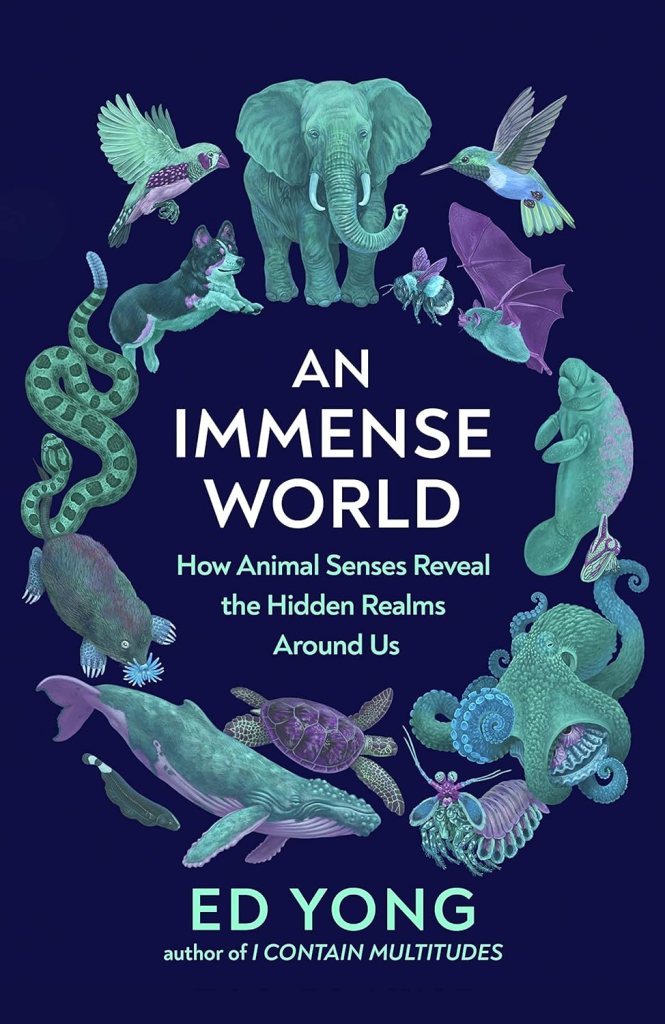
Ed Yong – An Immense World
My favourite non-fiction book of the year from my science journalism hero, An Immense World filled with so many fascinating facts about how animals perceive the world around them, but also funny and engagingly written. I spent much of June quoting passages from this book to everyone around me, much to their annoyance but also their begrudging “oh hey that’s actually pretty cool…”. If you enjoy reading about animals or are looking for a new perspective on the world around you, look no further.
Elamin Abdelmahmoud – Son of Elsewhere
A funny and moving memoir by CBC radio host Elamin Abdelmahmoud, a man who grew up in suburban Ontario around the same time with me and many of the same cultural reference points, but with a very different childhood and family history in Sudan. Would happily recommend.

Album of the Year: Slowdive – everything is alive
It’s not a book, but I did some of my best reading and writing this year to the tune of Slowdive’s latest album, so they get an honourable mention here. One of my favourite bands since high school, I have been tremendously pleased with their renaissance that began with their 2017 self-titled album. I hope they keep drinking from this particular well for many years to come!
Happy (belated) new year and happy reading!
 Coastally Curious