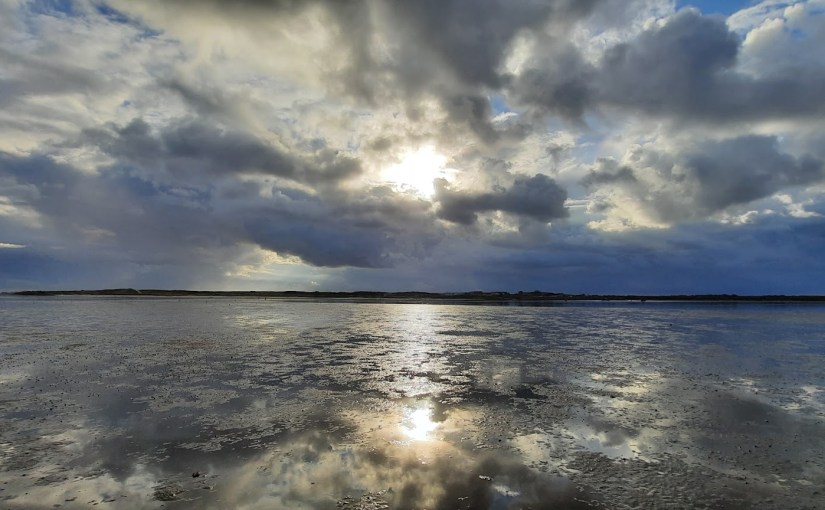
On one of the hottest days in recorded Dutch history, a bunch of ecologists, ecology-enthusiasts, and ecologist-enthusiasts gathered together in Utrecht to hear Tjitske Kooistra defend her PhD, Shifting sand: Benthos-sediment interactions in coastal ecosystems. As the sweat dripped down everyone’s faces, one of her research topics began to feel all-too relevant. How do creatures living on or in the seabed (benthic organisms) adapt to heat waves? At the end of the hour, Tjitske had survived being grilled by her committee, and emerged triumphantly as Dr. Kooistra!
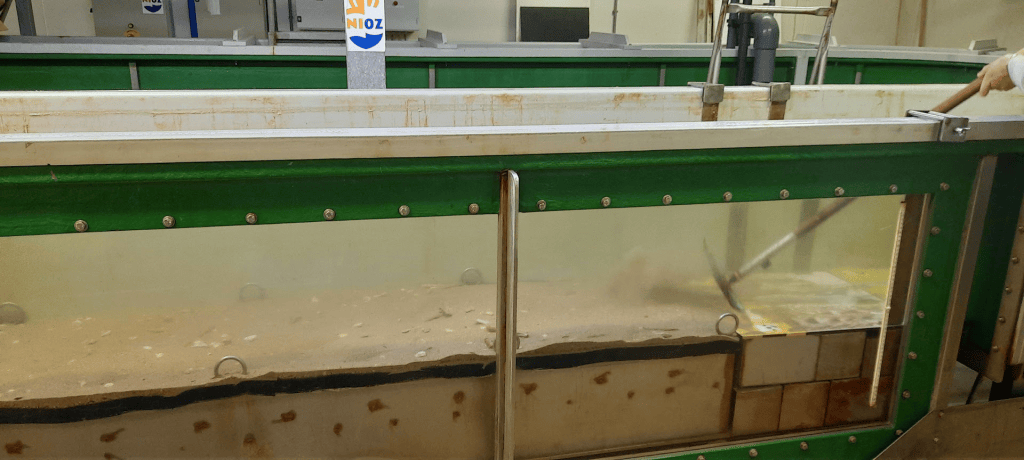
We first started working together during my postdoc and it has been such a privilege to supervise and watch her grow as a scientist. As an ecologist, she brought valuable expertise and skills to the TRAILS project, investigating the impact of environmental changes like heat or sediment coarsening on seafloor habitats. She may have started her PhD as an ecologist but she finished it as much more than that, making novel contributions to geochronology, sediment tracing & transport, and coastal engineering. Tjitske did field experiments in the sea and in the mud, in the north and in the south, and lab experiments in the flume and mesocosm. I learned so much from her and am extremely proud.
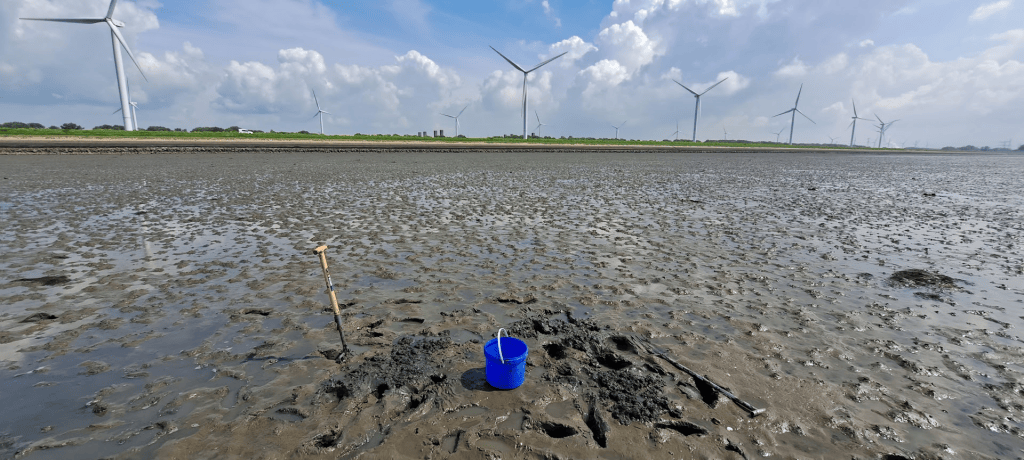
One of my favourite memories of working together with Tjitske involved tromping out across a mudflat in the Eastern Scheldt estuary in the south of the Netherlands. We were in search of the delightfully-named Peppery Furrow Clam (less delightfully in Latin, Scrobicularia plana), so that she could obtain some specimens for her lab experiments on heat wave impacts. We started combing through the mud with pitchforks, poking around for the elusive clam. After a few minutes, I very excitedly found my first clam! It was at that moment that I looked in Tjitske’s bucket and saw that she had already found about ten. This is what happens when a civil engineer and an ecologist go benthic sampling together…
We all have our preferred cozy habitats- I myself can be found in book stores and pubs, but the preferred home of many seafloor organisms in the Dutch Wadden Sea is a muddy tidal flat. In Coarsening coasts: quantifying sensitivity of benthic communities to sandification, Tjitske combed through huge datasets to identify these preferences, and then to highlight places where those organisms were not in their comfort zone. If the seafloor becomes coarser (more sand, less mud) due to sea level rise, increased wind and wave action due to larger or more frequent storms, or sand nourishments, then certain species that cannot adapt may be pushed out of their comfort zone – a problem for our aquatic ecosystems.
It’s not only the seafloor critters who are affected by the environment: through complex feedbacks, those critters also change the environment themselves, engineering their own ecosystem. In Worms and storms: shedding light on bioturbation and physical mixing on an intertidal flat by combining multiple tracers, Tjitske investigated how worms and other organisms mix the sand and mud in the top layers of the seabed, and tried to distinguish that from wave-induced changes.
My personal favourite paper that Tjitske wrote in her PhD showed How Shells of Different Shapes Affect Current-Driven Sand Transport. Anyone walking along the coast in bare feet has had the misfortune of standing on a seashell – yowch! The shells impede our progress along the beach. The same is true for the sand itself: Tjitske showed how the presence of seashells on the seafloor can alter sediment transport by increasing turbulence and armoring the bed. This is important because the models that we use for designing coastal safety measures may incorrectly predict how much sand is moved around if these shells are not accounted for.
For several years now, Tjitske also volunteered as a field instructor for our Advanced Coastal & Estuarine Systems course here at TU Delft. She led our students out on the mudflats, bringing a bunch of concrete-loving civil engineers directly in touch with the wonders of nature. Whenever we asked our students what their favourite part of the field trip was, the answer was invariably, “learning more about the ecological side of things with Tjitske!” Teaching civil engineers to care about worms is no mean feat, and is something that I believe will have lasting impact on how they think about their work.
Tjitske is now continuing her research on heat wave impacts as a postdoc at NIOZ. Way to go, Dr. Kooistra!

