
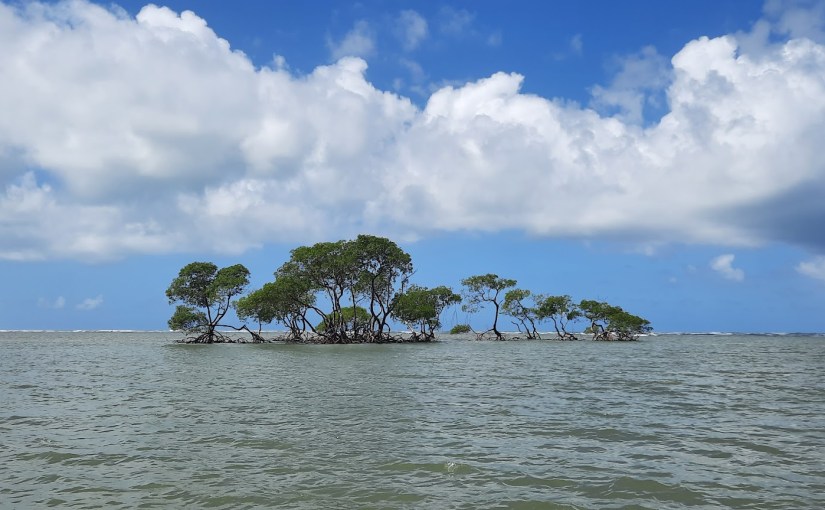
Mangrove forests provide valuable coastal habitats but also provide a natural form of coastal flood protection and a host of other services. However, many of these mangrove forests are threatened by coastal development and groundwater pumping-induced subsidence, among other natural and human changes. Part of the challenge is that mangroves are extremely choosy about their habitat, and need just the right combination of tidal submergence and mud to take root. If these habitats are thrown out of balance by people or natural causes, it becomes hard for new mangrove seedlings to grow there and sustain the forest.
To make happier places for the mangroves to develop, different kinds of coastal fences/dams have been proposed. The general principle is that waves and currents are attenuated or blocked by the fences, which makes a nice quiet area behind them for mud to accumulate and mangrove propagules to take root. What impact do these structures have on the coastal “conveyor belt” transporting mud and propagules? Enter Nirubha Raghavi Thillaigovindarasu!
Just before Christmas, Raghavi successfully defended her thesis, “Mangrove-Sediment Connectivity in the Presence of Structures Used to Aid Restoration“. Beginning with a numerical model of a site in Indonesia to simulate the motion of rivers and tides, she then applied the SedTRAILS model to visualize and interpret the pathways of sediment and mangrove propagules as they journeyed along the coast. By adding structures to her model, she was able to demonstrate how this trapping behaviour has an influence in the vicinity of a structure but also up to a kilometer away.

 Coastally Curious