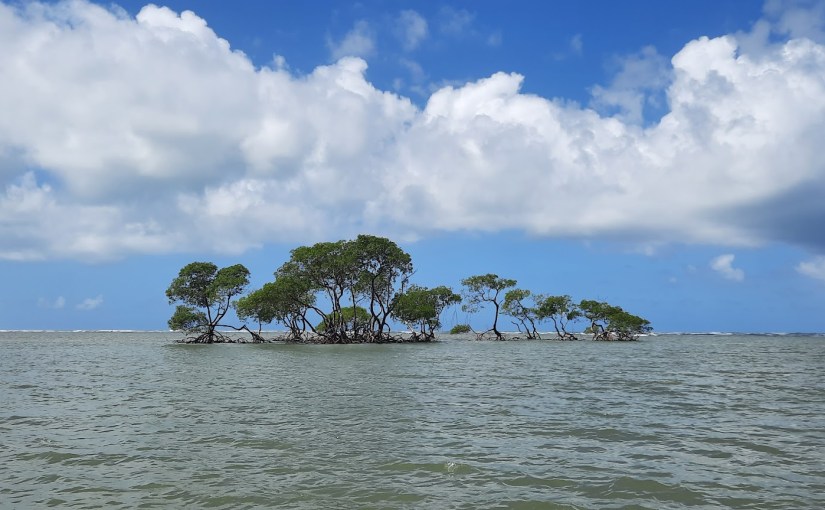
Mangrove forests protect tropical coastlines around the world from the effects of waves, in addition to providing valuable habitat for countless species. As such, their preservation and restoration is a key element of many plans for improving coastal resilience against flooding and erosion in the face of climate change. However, you can’t *just plant* a mangrove forest anywhere – mangroves are extremely picky, dancing on the edge of the intertidal zone where they get just wet enough but never too wet for too long. They also need safe, stable shorelines for their seedlings to take root and grow stronger, without too many waves and with just the right sort of muddy conditions to make a comfortable home.
Mangroves drop their seeds (called propagules) in the water, which then float around with the currents for days to weeks until they find a suitable home. But which pathways do these mangrove seedlings take as they float along the coast? Are those the same pathways that sand and mud take? These are questions that we need to answer in order to make better decisions about mangrove restoration. To get to the bottom of this, we recruited Femke Bisschop.
Last Friday, Femke successfully defended her thesis, “Modelling sediment and propagule pathways to improve mangrove rehabilitation: A case study of the pilot project in Demak, Indonesia“. She developed a numerical model of a site in Indonesia to simulate the motion of rivers and tides there, and then used the SedTRAILS model to visualize and interpret the pathways of sediment and mangrove propagules.
Continue reading Of Sediment and Seedlings

 Coastally Curious