Writing a Killer Conference Abstract

It’s that time again – the deadline for the next big conference in your field is fast approaching, and you are staring down a blank page. Where to start? How to make your abstract stand out and get noticed?

I recently had the opportunity to review conference abstracts for a major conference in our field. After reading over 50 abstracts for our session, the differences between outstanding abstracts and forgettable or insignificant ones became pretty clear. As I tried to articulate these thoughts for myself to evaluate the abstracts more consistently, I thought I should write it down for the benefit of the students that I supervise. I haven’t posted anything on here in a long time (sorry!), so then I also thought I would share it with the wider world in case it would be interesting for more of you.

Here are the most important things that I look for when evaluating conference abstracts:

Continue reading Writing a Killer Conference Abstract

Nature-Based Solutions for Salt Intrusion

When you think of coastal climate change impacts, what do you think of? Probably sea level rise, changes in wave climate or storminess, or loss of coastal habitat. But a silent intruder lurks: salty seawater, sneaking into estuaries and rendering our precious freshwater supplies undrinkable. The threat of estuarine salinity on deltas and coastal regions is one that I greatly underestimated, even as someone working in this field for over a decade. That is, until Gijs Hendrickx came along.

Last week Gijs Hendrickx successfully defended his PhD on Nature-Based Solutions to Mitigate Salt Intrusion! I think I speak for everyone involved when I say that we are SO proud of him.

Continue reading Nature-Based Solutions for Salt Intrusion

Veni!

Large populations near the sea are vulnerable to coastal floods, making coastal safety and sustainability an urgent societal priority. This is especially true in the Netherlands, where over a quarter of the country lies below sea level, and the main protection from deadly coastal floods is a barrier of wide, high sandy beaches and dunes. However, this sandy buffer is constantly moving and chronically eroding. To plan effective future coastal adaptations, we need to know where that sand is coming from, going to, and which paths it takes to get there. I am delighted to share that I have just received a Veni grant from the Dutch Research Council (NWO) to investigate this!

Where is the sand on beaches going, and how does it get there?

My overarching goal is to enable effective sediment-based climate adaptation strategies for vulnerable coasts. To approach this, I consider coasts as an interconnected network of sediment pathways, like a subway map showing how stations are linked. This connectivity reveals the hidden structure underlying chaotic sediment pathways through coastal systems. These pathways are immensely difficult to identify on real coasts due to the challenge of tracking individual sand grains from multiple sources in such a dynamic environment.

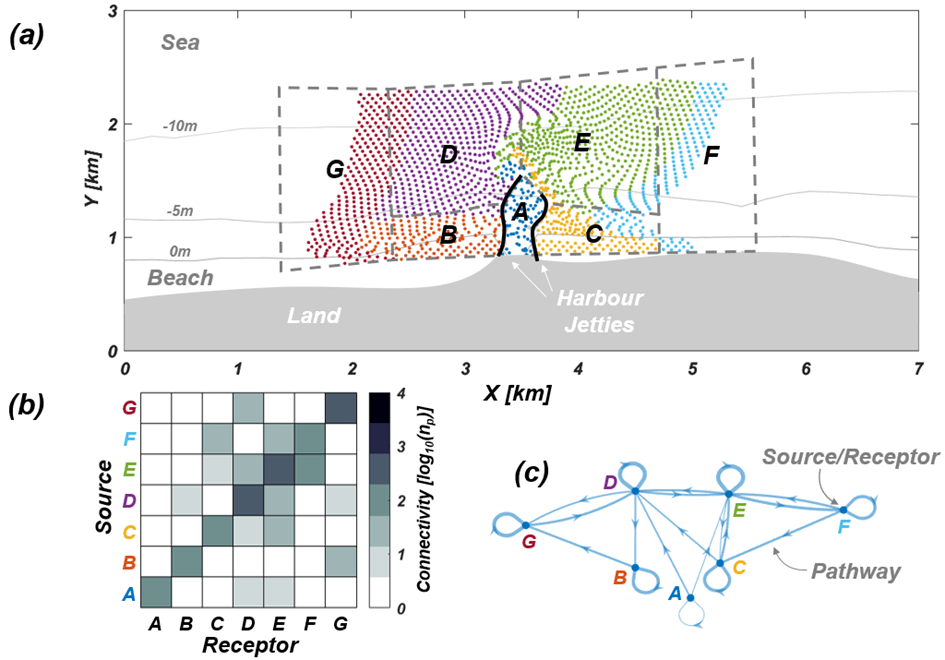
Proof-of-concept connectivity analysis of a beach and harbour.
(a) Map of tracer particles in example SedTRAILS model from 7 different source patches at a snapshot in time. (b) The number of particles (np) from a given source in each receptor is counted to yield a connectivity matrix, graphically represented by a connectivity network diagram (c).

To deal with this challenge, this grant will enable me to develop both a scale model in a physical laboratory and a numerical model in a digital laboratory. In a wave tank the size of an Olympic swimming pool, I will construct a beach from multi-coloured sand. As waves disperse the sand, the resulting rainbow of sediment will reveal their pathways, which I will then quantify as a network in the digital laboratory. The resulting open datasets and numerical models will serve as a benchmark for the coastal research community, generating new theories and improved tools. My collaborators in the Netherlands, US, and New Zealand will help me to implement these findings in research, engineering practice, and coastal management policy. In this way I hope to enable more effective management of sediment for coastal adaptation and a more holistic understanding of our coastal systems.

Stay tuned for more updates once the project begins!

Cracking the Code of Resonant Wave Signals

Coral reefs act as essential flood protection for low-lying tropical coasts, something that is making the news frequently these days. However, as I have explained before on this website, Weird Waves Cause Big Trouble on Small Islands in the Middle of the Big Blue Wet Thing. Essentially, some coral reefs have a tendency to excite normally idyllic swell waves into dangerous resonant low-frequency waves that can act like mini-tsunamis and flood vulnerable low-lying tropical islands. When pushing a child on a swing, you can send them higher and higher with relatively little effort by timing your pushes carefully. In the same manner, waves striking a coral reef can be naturally amplified higher and higher if they are timed at just the right frequency. This can happen even on a sunny day – big storms not necessary! Suffice it to say, this is bad news for islands that are already barely above sea level.

Over the past decade or so, research on this topic by my colleagues and I has focused mostly on how the shape of the coral reef, specific wave conditions, or the combination of both can lead to resonant conditions. But up until now, we have largely stuck to the simplifying assumption that once resonant conditions are met, they stay that way for a while. But is this actually the case? How long do resonant conditions last on coral reefs, when do they occur, and what are the consequences for flooding?

To get to the bottom of this, Bernice van der Kooij came to the rescue! Last week she successfully defended her master’s thesis, Exploring Transient Resonant Behaviour over a Fringing Coral Reef. In Bernice’s thesis (which is simply a joy to say out loud), she dove deep into the mechanics of a complex mathematical technique, the Hilbert-Huang Transform. Bernice did some extremely difficult work that certainly kept her thesis committee on its toes. Armed with this approach, she managed to find that while these intense low-frequency wave conditions typically lasted about 5 minutes, they tended to last for hours during major flooding events.

Bernice’s study used wave measurements from the island of Roi-Namur in the Marshall Islands. Roi Namur is an extremely vulnerable island – several months ago, horrific low-frequency waves like the ones that Bernice studied struck the island. As you can see in this video of the event (which I found quite upsetting and is NOT for the faint of heart), the waves do not resemble the waves you normally see on the beach with crests spaced a few seconds apart. Instead, they smash through the building like tsunamis and then just keep coming for minutes at a time before the crest subsides (this is what “low-frequency” means). Fortunately but remarkably, there were only minor injuries from that incident, but if these events occur more frequently as climate change escalates, not everyone will be so lucky in the future. My colleagues at the US Geological Survey and Deltares argue that most atolls like Roi-Namur will be uninhabitable by the mid-21st century because of sea-level rise exacerbating this sort of wave-driven flooding.

These floods underscore the urgency of the problem Bernice worked on, and we are very proud of her and her research. We wish her all the best in the next steps of her career!

PhD Opportunity: Nourishment Hydrodynamics and Sediment Transport (SOURCE)

My colleague Matthieu de Schipper and I are looking for a new PhD candidate as part of the large SOURCE research project! SOURCE stands for Sand nourishment strategies for sustainable Coastal Ecosystems. The SOURCE philosophy is that carefully planned sand nourishments now will create the required and desired resilient and dynamic multifunctional coastal landscapes of the future.

Sand nourishment has been essential in the Dutch government’s strategy to sustainably maintain flood protection levels along the Dutch coast for more than 30 years. Nourishment volumes are projected to increase to keep up with the expected acceleration in sea level rise. However, we currently lack fundamental knowledge on how the nourished sand finds its way through the coastal system, and what the long-term, cumulative effects are for the coast as an ecosystem. For instance, we know that beaches that are nourished with sand in the nearshore are eroding less, but which sediment is accumulating on the landward beach is still unknown. Likewise it is still unknown which hydrodynamic and sediment transport processes dominate in the vicinity of a nourishment.

In its entirety, the SOURCE research team will deliver the scientific knowledge, models and design tools to develop and evaluate nourishment strategies in a multi-stakeholder co-creation process. Our Living Labs are two sand nourishments along the Dutch coast. These will be co-designed, monitored and evaluated by the SOURCE consortium (in particular the 12 PhD and postdoc researchers at 8 academic institutes in total) in collaboration with 25 partners from government organizations, research institutes, nature organizations and industry.

As part of the SOURCE project, the PhD candidate at Delft University of Technology will examine the morphological development of shoreface nourishments. Understanding the hydrodynamics and sediment transport are key in this research. You will therefore use state-of-the-art field equipment and strategic numerical modelling to unravel the physical processes shaping nourishments. This will ultimately contribute to the robustness of (Dutch) sandy coasts to climate change and the safety of its people against flood hazards.

You will:

  1. Plan, execute and analyse field observations at a nourished beach to better understand the impact of nourishments on the hydrodynamics, sediment transport, and morphological evolution.
  2. Use strategic modelling to predict coastal sediment pathways at recently nourished beaches and the origin of sediment accumulated in the lee side.
  3. Combine data and findings of multiple nourishment projects to show the link between engineering design and coastal settings on the nourishment performance. This step will require you to collaborate with government and industry partners (abroad).
  4. Collaborate with academic partners in the SOURCE project to translate quantitative metrics of physical beach response to ecological and socio-economic impacts.

At TU Delft, you will be part of the Coastal Engineering section where we combine research on hydrodynamics, morphodynamics, and human interventions to the coast using numerical modelling and field measurements. You will primarily work with Matthieu de Schipper and myself (Stuart Pearson), embedded within a larger ecosystem of research partners.

More information about the topic and the application process can be found here.

Come join our team! Feel free to get in touch with us (s.g.pearson@tudelft.nl) if you have any questions. Applications close July 21st, 2024!
Book Club (2023)

Belated happy new year! I wrote this post while waiting for a delayed flight back to the Netherlands over a month ago, but never got around to uploading it. After clawing my way out of the gluttonous vortex that is the week between Christmas and New Year’s Eve, I found myself in a bit of a reflective mood. 2023 was a year full of personal changes and transitions (a new job, among others), and I have much to be grateful for. It has also been a turbulent year for humanity, with climate change rearing its ugly head in new and worrying ways, and growing conflicts around the world, especially in the Gaza and the Ukraine.

However, a dependable constant through these many changes has been a steady diet of books. After sharing my favourite books of 2022, I thought I would do the same again this year. Again, they are presented in more or less the order that I read them, and they include books that devoured my attention, changed my perspective, or just made me laugh. None of these books have anything to do with coastal engineering and most are fiction, but I am a firm believer that reading widely is good for your research and more importantly for the soul. Hopefully you find something here that sparks your curiosity- let me know what you think if you read any of them!

Continue reading Book Club (2023)

Saving the Mangroves, One Fence at a Time

Mangrove forests provide valuable coastal habitats but also provide a natural form of coastal flood protection and a host of other services. However, many of these mangrove forests are threatened by coastal development and groundwater pumping-induced subsidence, among other natural and human changes. Part of the challenge is that mangroves are extremely choosy about their habitat, and need just the right combination of tidal submergence and mud to take root. If these habitats are thrown out of balance by people or natural causes, it becomes hard for new mangrove seedlings to grow there and sustain the forest.

To make happier places for the mangroves to develop, different kinds of coastal fences/dams have been proposed. The general principle is that waves and currents are attenuated or blocked by the fences, which makes a nice quiet area behind them for mud to accumulate and mangrove propagules to take root. What impact do these structures have on the coastal “conveyor belt” transporting mud and propagules? Enter Nirubha Raghavi Thillaigovindarasu!

Just before Christmas, Raghavi successfully defended her thesis, “Mangrove-Sediment Connectivity in the Presence of Structures Used to Aid Restoration“. Beginning with a numerical model of a site in Indonesia to simulate the motion of rivers and tides, she then applied the SedTRAILS model to visualize and interpret the pathways of sediment and mangrove propagules as they journeyed along the coast. By adding structures to her model, she was able to demonstrate how this trapping behaviour has an influence in the vicinity of a structure but also up to a kilometer away.

Example of bamboo fence constructed near Demak, Indonesia, for the purposes of restoring mangrove forests to the coastal region there. Photo: BioManCo project (Alejandra Gijon Mancheno, Silke Tas, Celine van Bijsterveldt).
Continue reading Saving the Mangroves, One Fence at a Time

PhD Opportunity: Coastal Sediment Connectivity

How can we ensure that vulnerable coasts and deltas remain robust to the effects of climate change? We need to better understand how sediment moves along our coasts and deltas, and plan to do so by treating coastal systems as networks of interconnected sediment pathways.

We are looking for a curious and motivated PhD candidate to work with us on an exciting project here at TU Delft in the Netherlands. The main goal of this position is to develop novel approaches to quantify sediment pathways and connectivity, and to use these approaches to inform coastal sediment management.

Our main strategy for ensuring the climate-robustness of the Dutch coast is to nourish or place sand to widen its beaches and dunes. However, the fate of sand placed on the coast is still poorly understood in the context of the full coastal system. Understanding where nourished sand goes is necessarily rooted in understanding the natural sediment transport pathways and connectivity of the system. To take advantage of advances in the field of network analysis and extend these concepts to analyzing sediment transport pathways in coastal systems, we established the framework of coastal sediment connectivity (Pearson et al., 2020).

In this project, you will advance coastal engineering by introducing established techniques from other fields (e.g., network analysis) in a novel way to understand and predict sediment transport. These techniques will yield a new and useful toolbox of methods for predicting and understanding sediment pathways, and enable more efficient and effective nourishment design and execution. This will ultimately contribute to the robustness of the Dutch coast to climate change and the safety of its people against flood hazards.

In this PhD, you will:

  1. Apply network analysis techniques to better understand how sediment pathways are connected at small/short and large/long space/time scales.
  2. Use coastal sediment connectivity networks to probabilistically model sediment pathways via Markov chains or machine learning approaches.
  3. Quantify (a)synchronization of coastal sediment networks and relate to hydrodynamic forcing.
  4. Relate quantitative metrics of network structure to practical coastal management goals (eg, identifying resilience or tipping points).

At TU Delft, you will be part of the Coastal Engineering section where we combine research on hydrodynamics, morphodynamics, and human interventions to the coast using numerical modeling and field measurements. You will primarily work with me (Stuart Pearson) and Ad Reniers, embedded within a larger ecosystem of research partners.

More information about the topic and the application process can be found here: https://www.tudelft.nl/over-tu-delft/werken-bij-tu-delft/vacatures/details?jobId=14744

Come join our team! Feel free to get in touch with us (s.g.pearson@tudelft.nl) if you have any questions. Applications close November 30th, 2023!

Of Shells & Sand

Have you ever walked along a windy beach and noticed shells sitting atop small peaks of sand, like a miniature mountain range? Does a shell “protect” the sand underneath, or does the sand pile up behind it? Does the shell actually cause more erosion around it? How does a shell affect the way sand moves along beaches? What happens when you have millions of shells along a beach? Does that affect the way the beach as a whole erodes? Now what about the parts of a beach that we can’t see, below the water?

Shells emerging from the beach on little pedestals of sand

These might seem like the thoughts of an idle beachgoer, but are actually essential to helping us understand how to sustainably protect our coasts. As part of the TRAILS project, Tjitske Kooistra is investigating how sand nourishments influence sensitive ecosystems on the Dutch coast. In order to do that, we need to understand how shells and sand interact at the bottom of the sea, since there are many locations along the Dutch coast where shells make up a significant portion of the beach material. This is really difficult to understand in the field, so to figure this out in a more controlled setting, Tjitske planned a series of lab experiments and we recruited Steven Haarbosch to carry them out.

After months of hard work shovelling sand and crunching numbers, Steven successfully defended his thesis, “The influence of bivalve shells of different shapes and sizes on current-driven sediment transport“! He conducted excellent, tremendously useful research, and I am really proud of what he accomplished.

Continue reading Of Shells & Sand

The Cappuccino Effect

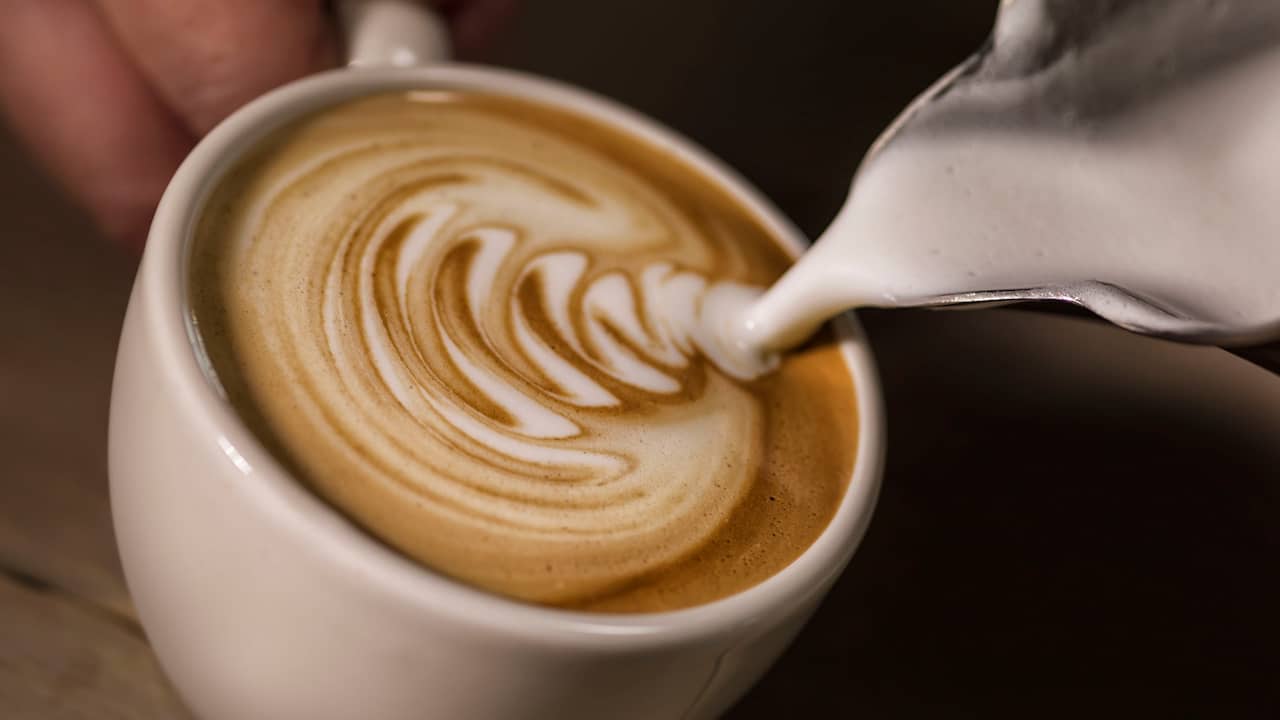
Do you ever think about the swirling patterns in your cappuccino as you stir your spoon around, the brown coffee folding in past the white foam? And do you ever think about sediment transport as you do it? Just me? Ok, never mind…

I had the great privilege of hanging out in New Orleans this past week, being a sand nerd with four hundred of my fellow sand nerds at the Coastal Sediments conference. In between jazz sets at the Spotted Cat, we shared our latest ideas about coastal dynamics, built new collaborations, and rekindled old pre-pandemic friendships. My contribution this year was an attempt to bring the science behind cappuccino coffee swirls to coastal sediment transport.

Continue reading The Cappuccino Effect