PhD Opportunity: Nourishment Hydrodynamics and Sediment Transport (SOURCE)

My colleague Matthieu de Schipper and I are looking for a new PhD candidate as part of the large SOURCE research project! SOURCE stands for Sand nourishment strategies for sustainable Coastal Ecosystems. The SOURCE philosophy is that carefully planned sand nourishments now will create the required and desired resilient and dynamic multifunctional coastal landscapes of the future.

Sand nourishment has been essential in the Dutch government’s strategy to sustainably maintain flood protection levels along the Dutch coast for more than 30 years. Nourishment volumes are projected to increase to keep up with the expected acceleration in sea level rise. However, we currently lack fundamental knowledge on how the nourished sand finds its way through the coastal system, and what the long-term, cumulative effects are for the coast as an ecosystem. For instance, we know that beaches that are nourished with sand in the nearshore are eroding less, but which sediment is accumulating on the landward beach is still unknown. Likewise it is still unknown which hydrodynamic and sediment transport processes dominate in the vicinity of a nourishment.

In its entirety, the SOURCE research team will deliver the scientific knowledge, models and design tools to develop and evaluate nourishment strategies in a multi-stakeholder co-creation process. Our Living Labs are two sand nourishments along the Dutch coast. These will be co-designed, monitored and evaluated by the SOURCE consortium (in particular the 12 PhD and postdoc researchers at 8 academic institutes in total) in collaboration with 25 partners from government organizations, research institutes, nature organizations and industry.

As part of the SOURCE project, the PhD candidate at Delft University of Technology will examine the morphological development of shoreface nourishments. Understanding the hydrodynamics and sediment transport are key in this research. You will therefore use state-of-the-art field equipment and strategic numerical modelling to unravel the physical processes shaping nourishments. This will ultimately contribute to the robustness of (Dutch) sandy coasts to climate change and the safety of its people against flood hazards.

You will:

  1. Plan, execute and analyse field observations at a nourished beach to better understand the impact of nourishments on the hydrodynamics, sediment transport, and morphological evolution.
  2. Use strategic modelling to predict coastal sediment pathways at recently nourished beaches and the origin of sediment accumulated in the lee side.
  3. Combine data and findings of multiple nourishment projects to show the link between engineering design and coastal settings on the nourishment performance. This step will require you to collaborate with government and industry partners (abroad).
  4. Collaborate with academic partners in the SOURCE project to translate quantitative metrics of physical beach response to ecological and socio-economic impacts.

At TU Delft, you will be part of the Coastal Engineering section where we combine research on hydrodynamics, morphodynamics, and human interventions to the coast using numerical modelling and field measurements. You will primarily work with Matthieu de Schipper and myself (Stuart Pearson), embedded within a larger ecosystem of research partners.

More information about the topic and the application process can be found here.

Come join our team! Feel free to get in touch with us (s.g.pearson@tudelft.nl) if you have any questions. Applications close July 21st, 2024!
Sand: Nourishment at Ameland

The main protective barrier for the Netherlands against the threat of flooding from the sea is a row of colossal sand dunes and wide beaches that stretch the length of their coast.  However, that barrier is not completely natural —  since the Dutch coast is in a constant state of erosion, the sand in their coastal zone has to be continually replenished.  This replenishment takes the form of nourishments, which are essentially just massive piles of sand placed on beaches, dunes, or just offshore.  The Dutch are lucky, since the bottom of the North Sea is covered in sand for hundreds of kilometers in every direction, meaning that there is a ready supply available for this purpose.

Although we still have plenty to learn about how to construct these nourishments effectively and in an environmentally friendly way, we are starting to get the hang of it — at least for long, straight, sandy coastlines like in Holland.  However, this all gets a bit trickier when we turn our attention to the Wadden Islands dotting the northern coast of the Netherlands.  These little islands sit between the stormy North Sea and the shallow Wadden Sea, a large estuary whose ecological value is unmatched in the Netherlands.

The coast of these islands is punctuated by a series of inlets connecting the two seas.  Chaos reigns at these inlets, where strong tidal currents pass in and out, clashing with waves and whisking sandy shoals in and out of existence in unpredictable ways.  This makes the inlets treacherous for ships, but also a challenge to simulate with our computer models and design nourishments for.

How, then, are are we meant to nourish the coast of these islands?  We want to keep their inhabitants (and those on the nearby mainland) safe from flooding, but also need to be careful about inadvertently disrupting the vital ecological habitat of the Wadden Sea.

To answer that question, the Dutch government initiated the Kustgenese or Coastal Genesis project. In collaboration with several Dutch universities, companies, and research institutes, they set out to better understand how these tidal inlets work, and whether it is possible to effectively nourish them.  The project focuses on Ameland Inlet, which is located between the islands of Ameland and Terschelling.


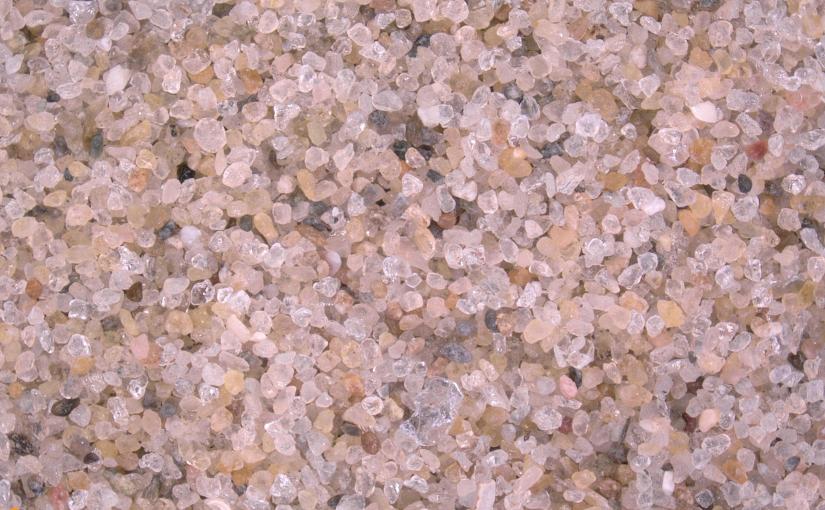
My PhD project is but a very tiny piece of the very large Kustgenese pie.  My goal is to figure out specifically how the size of sand grains affects the paths that they take around tidal inlets.  It has been the dream job for someone who has loved playing in the sand ever since he was a little kid.  As a result, it has entailed a lot of time at my computer and in the laboratory, investigating the characteristics of the sand in Ameland inlet (that’s also why I have so many pictures of sand on this blog- we have a really cool microscope!).  It is very fine sand and would be absolutely perfect for squidging your toes through on a hot day — if it weren’t at the bottom of the sea, that is:

NativeSediment
Native sediment from Ameland ebb-tidal delta

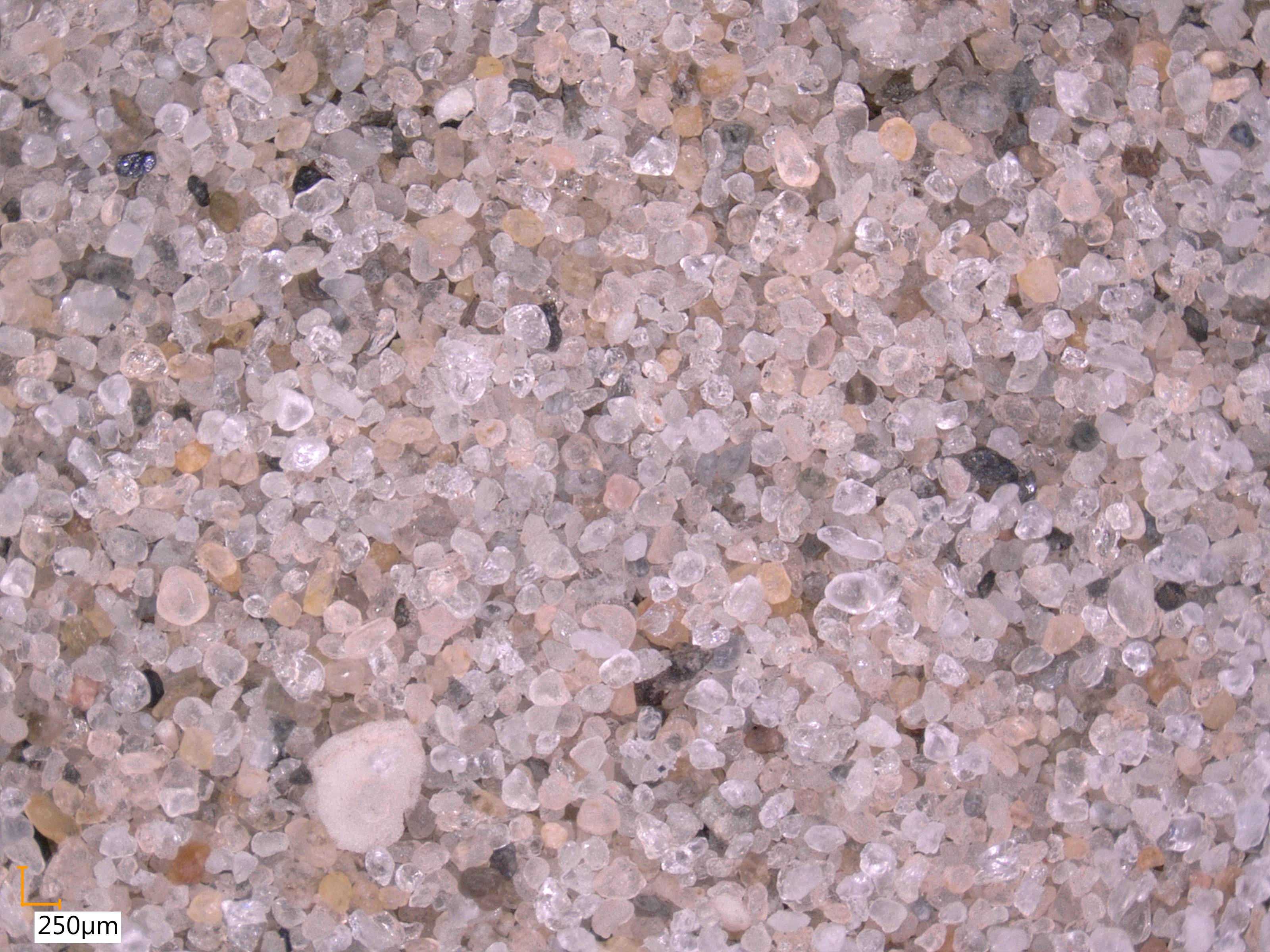
In the spirit of ‘why not?’, the Dutch government decided that the best way to test whether nourishments would be effective in this environment was to just go ahead and try one out last year.  They dredged up 5 million cubic metres of sand (that’s enough to fill 3 Skydomes, for anyone reading this back home in Toronto) and placed them just outside the inlet.  A few months ago, one of the Dutch government officials showed up at a meeting with a “present” for me… some sand from the nourishment!

NourishmentSediment
Nourishment sediment dredged from offshore and placed on Ameland ebb-tidal delta.

Needless to say, I was very excited.  At first glance, it appears quite similar to the native sediment, so that means it should behave in a similar manner.  Time will tell how the nourishment evolves- we are watching very closely!