When you think of coastal climate change impacts, what do you think of? Probably sea level rise, changes in wave climate or storminess, or loss of coastal habitat. But a silent intruder lurks: salty seawater, sneaking into estuaries and rendering our precious freshwater supplies undrinkable. The threat of estuarine salinity on deltas and coastal regions is one that I greatly underestimated, even as someone working in this field for over a decade. That is, until Gijs Hendrickx came along.
Coral reefs act as essential flood protection for low-lying tropical coasts, something that is making the newsfrequentlythese days. However, as I have explained before on this website, Weird Waves Cause Big Trouble on Small Islands in the Middle of the Big Blue Wet Thing. Essentially, some coral reefs have a tendency to excite normally idyllic swell waves into dangerous resonant low-frequency waves that can act like mini-tsunamis and flood vulnerable low-lying tropical islands. When pushing a child on a swing, you can send them higher and higher with relatively little effort by timing your pushes carefully. In the same manner, waves striking a coral reef can be naturally amplified higher and higher if they are timed at just the right frequency. This can happen even on a sunny day – big storms not necessary! Suffice it to say, this is bad news for islands that are already barely above sea level.
Over the past decade or so, research on this topic by my colleagues and I has focused mostly on how the shape of the coral reef, specific wave conditions, or the combination of both can lead to resonant conditions. But up until now, we have largely stuck to the simplifying assumption that once resonant conditions are met, they stay that way for a while. But is this actually the case? How long do resonant conditions last on coral reefs, when do they occur, and what are the consequences for flooding?
To get to the bottom of this, Bernice van der Kooij came to the rescue! Last week she successfully defended her master’s thesis, Exploring Transient Resonant Behaviour over a Fringing Coral Reef. In Bernice’s thesis (which is simply a joy to say out loud), she dove deep into the mechanics of a complex mathematical technique, the Hilbert-Huang Transform. Bernice did some extremely difficult work that certainly kept her thesis committee on its toes. Armed with this approach, she managed to find that while these intense low-frequency wave conditions typically lasted about 5 minutes, they tended to last for hours during major flooding events.
These floods underscore the urgency of the problem Bernice worked on, and we are very proud of her and her research. We wish her all the best in the next steps of her career!
Mangrove forests provide valuable coastal habitats but also provide a natural form of coastal flood protection and a host of other services. However, many of these mangrove forests are threatened by coastal development and groundwater pumping-induced subsidence, among other natural and human changes. Part of the challenge is that mangroves are extremely choosy about their habitat, and need just the right combination of tidal submergence and mud to take root. If these habitats are thrown out of balance by people or natural causes, it becomes hard for new mangrove seedlings to grow there and sustain the forest.
To make happier places for the mangroves to develop, different kinds of coastal fences/dams have been proposed. The general principle is that waves and currents are attenuated or blocked by the fences, which makes a nice quiet area behind them for mud to accumulate and mangrove propagules to take root. What impact do these structures have on the coastal “conveyor belt” transporting mud and propagules? Enter Nirubha Raghavi Thillaigovindarasu!
Just before Christmas, Raghavi successfully defended her thesis, “Mangrove-Sediment Connectivity in the Presence of Structures Used to Aid Restoration“. Beginning with a numerical model of a site in Indonesia to simulate the motion of rivers and tides, she then applied the SedTRAILS model to visualize and interpret the pathways of sediment and mangrove propagules as they journeyed along the coast. By adding structures to her model, she was able to demonstrate how this trapping behaviour has an influence in the vicinity of a structure but also up to a kilometer away.
Have you ever walked along a windy beach and noticed shells sitting atop small peaks of sand, like a miniature mountain range? Does a shell “protect” the sand underneath, or does the sand pile up behind it? Does the shell actually cause more erosion around it? How does a shell affect the way sand moves along beaches? What happens when you have millions of shells along a beach? Does that affect the way the beach as a whole erodes? Now what about the parts of a beach that we can’t see, below the water?
Shells emerging from the beach on little pedestals of sand
These might seem like the thoughts of an idle beachgoer, but are actually essential to helping us understand how to sustainably protect our coasts. As part of the TRAILS project, Tjitske Kooistra is investigating how sand nourishments influence sensitive ecosystems on the Dutch coast. In order to do that, we need to understand how shells and sand interact at the bottom of the sea, since there are many locations along the Dutch coast where shells make up a significant portion of the beach material. This is really difficult to understand in the field, so to figure this out in a more controlled setting, Tjitske planned a series of lab experiments and we recruited Steven Haarbosch to carry them out.
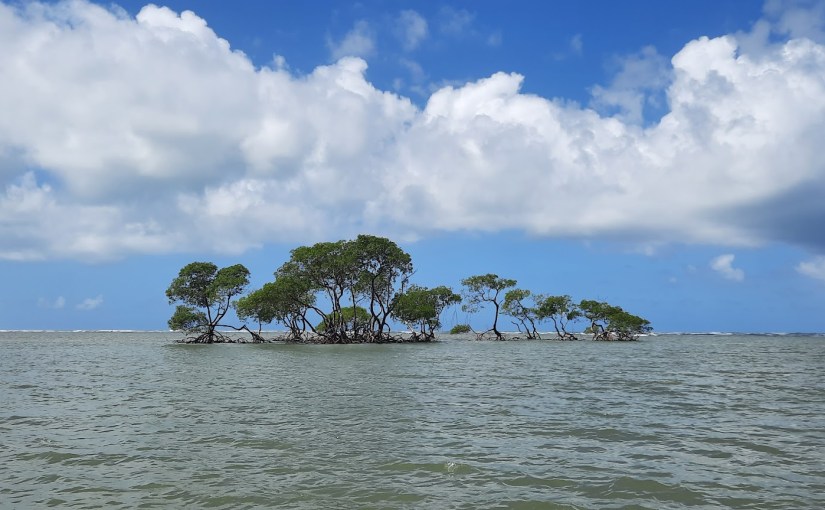
Mangrove forests protect tropical coastlines around the world from the effects of waves, in addition to providing valuable habitat for countless species. As such, their preservation and restoration is a key element of many plans for improving coastal resilience against flooding and erosion in the face of climate change. However, you can’t *just plant* a mangrove forest anywhere – mangroves are extremely picky, dancing on the edge of the intertidal zone where they get just wet enough but never too wet for too long. They also need safe, stable shorelines for their seedlings to take root and grow stronger, without too many waves and with just the right sort of muddy conditions to make a comfortable home.
Mangroves drop their seeds (called propagules) in the water, which then float around with the currents for days to weeks until they find a suitable home. But which pathways do these mangrove seedlings take as they float along the coast? Are those the same pathways that sand and mud take? These are questions that we need to answer in order to make better decisions about mangrove restoration. To get to the bottom of this, we recruited Femke Bisschop.
Big news to start 2023: I am now an Assistant Professor in Coastal Engineering here at TU Delft! An opening appeared online last summer, and after weeks of preparing applications, several rounds of interviews and a teaching demonstration, and a lot of waiting, I finally got the good news. This has been my dream job for a long time and I can’t believe it came true.
Officially, my new portfolio will focus on “Climate-Robust Deltas”. How does sediment contribute to the strength and adaptability of our coasts and deltas against the effects of sea level rise and climate change? In my research we approach this gigantic problem by quantifying sediment pathways and connectivity for strategic placement of sediment, using a combination of numerical modelling and field measurements. In the coming years, I hope to build up a diverse team of enthusiastic, coastally curious researchers to tackle these challenges. Stay tuned for opportunities to join our group!
At the end of June, we will welcome a group of about a dozen American PhD students for our second annual IRES summer school, hosted at Deltares/TU Delft/Utrecht University and organized by the University of New Orleans and The Water Institute of the Gulf in Louisiana.
Last year we hosted 14 American PhD students for two (fully funded!) weeks in beautiful Delft. It includes D-Flow FM model training, cool field trips to sites around the Netherlands, a lab session, networking galore, guest lectures, and time for exploring the area. Last year everyone seemed to learn a lot and have a pretty good time (I sure did!). We have a great team and are excited to make it even better this year. Please share this with anyone in your network whom you know might be interested!
More details can be found in the pdf below. If you are interested you can apply here before January 27th, 2023. We will host the summer school for a third and final time in 2024, so if you are too late or ineligible this year, stay tuned for another chance next year!
Tropical cyclones or hurricanes threaten the lives of millions and cause billions of dollars in damage every year. To estimate flood risks at a particular location, scientists and engineers typically start by looking at the historical record of all previous storms there. From these records, they can statistically predict how likely a storm of a given size is (e.g., the biggest storm likely to occur there in 100 years).
There are two problems with this approach: (1) What if there isn’t much historical data in the records? This is often the case for Small Island Developing States (SIDS) and in the Global South. If you don’t have enough data points (particularly for rarer, more extreme events), your statistical estimates will be much more uncertain. (2) What if the historical record isn’t representative of the conditions we are likely to see in the present and future? This is also a big problem in light of climate change, which is expected to bring sea level rise and changes in storminess to coasts around the world.
To address these challenges, our team led by Tije Bakker came up with a new approach to estimating tropical cyclone-induced hazards like wind, waves, and storm surge in areas with limited historical data. Our findings are now published open-access in Coastal Engineering here!
Originally presented earlier today at the AGU 2021 Fall Meeting in the “Upgoer Five” Session, this video was inspired by the XKCD comic and book in which scientific concepts are described using only the 1000 most-common words in the English language. I participated in the session last year and had so much fun, I thought I would try it again with my coral reef research.
Unfortunately, ”ocean” and ”sea” were not on the list, so I had to go with ”big blue wet thing” instead. Want to give it a try yourself? Here is a handy tool which checks your writing to see if it meets the list of 1000 most common words: https://splasho.com/upgoer5/ It’s harder than it looks!
Here is a summary of my video:
Some small but beautiful lands in the middle of the big blue wet thing were built by tiny animals that turn into rock when they die. Although these lands might seem perfect and calm most of the time, they are actually in big trouble. The big water is going up and up and up, and the little lands could be completely under it before our kids grow old. However, they are also in trouble right now — waves can hit the little lands and make them go under the water too, even if just for a short while. These waves can hurt people and make the drinking water not-drink-able. It is hard to guess if the waves will cause trouble because they break in different ways than we are used to when they hit the rocks built by animals. The waves become longer and weirder as they move across the rocks, and can hit the land with more power than we would expect. It is even harder to guess what the waves will do because every small land made of rocks built by animals is different, and there are so many of them all around the world. To keep everyone safe, we showed a computer lots of made-up waves so that it could learn how waves look when they hit different sorts of rocks and land. The computer can then make good guesses about what real waves would do if they hit real rocks and land. If the computer thinks that the waves will cause trouble, we can warn people to go somewhere safer until the waves stop. In this way, we hope to keep everyone’s feet dry until long after our kids are old.
You can find more about this stuff in bigger words here:
1. Pearson, S.G., Storlazzi, C.D., van Dongeren, A.R., Tissier, M.F.S., & Reniers, A.J.H.M. (2017). A Bayesian‐based system to assess wave‐driven flooding hazards on coral reef‐lined coasts. Journal of Geophysical Research: Oceans, 122(12), 10099-10117. https://doi.org/10.1002/2017JC013204
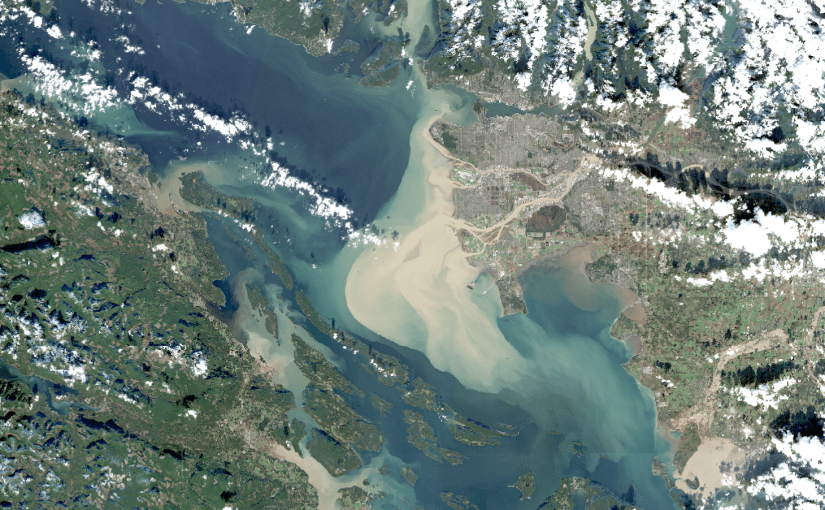
In the past few weeks, Vancouver and the BC Lower Mainland have suffered not just one but three record-breaking rainstorms, a succession of ”atmospheric rivers” that dumped several hundred millimetres of rain. Highways washed out and disappeared, and numerous communities were flooded. This resulted in an enormous quantity of sediment reaching the sea via the Fraser and other local rivers. But where exactly does the sediment that’s already in the sea around Vancouver go? How has that changed in the past few hundred years since Europeans colonized the area? To get to the bottom of this, we enlisted Carlijn Meijers.
Last week, Carlijn successfully defended her thesis, ”Sediment transport pathways in Burrard Inlet”. To answer these questions, she created a detailed hydrodynamic and sediment transport model of Burrard Inlet and Georgia Strait in D-Flow FM. She then used the SedTRAILS model that we have developed to visualize sediment transport pathways.
Modelled sediment transport pathways in Burrard Inlet. The red arrows highlight key patterns in the SedTRAILS particle trajectories. Burrard inlet is characterized by strong flows through the narrowest points of the fjord, and large eddies in the wider areas. Source: Meijers (2021).
From these models, Carlijn showed that sediment transport is largely controlled by flow through the First and Second Narrows (where the Lion’s Gate and Ironworker’s Memorial bridges cross). As the tide comes in, the water shoots through these narrow passages at speeds of up to 2 m/s and comes out the far side as a jet, spiraling off into eddies. The tide then goes out and the same happens in reverse, with water shooting out the opposite side.
Conceptual diagram showing the dominant sediment pathways in the Inner Harbour. Source: Meijers (2021).
Due to the sheltered nature of the inlet, waves have only a minor role in sediment transport. However, given the intensity of the tides and the great depths of Burrard Inlet (especially the Indian Arm fjord to the north), most sediment liberated by erosion tends to get carried away from shore and is essentially lost from the coastal sediment budget.
Another key point of her project was to investigate how land use changes and other human effects (e.g., damming rivers, port construction) have changed Burrard Inlet. Using the model, Carlijn showed that these changes to the inlet have shrunken its tidal prism, influencing the currents and sediment transport patterns.
Comparison of the present-day shoreline with the high and low tide lines from 1792, prior to colonization by European settlers. The Second Narrows are so narrow because they were formed by the delta of Seymour River and Lynn Creek. The area has since been dredged and walled off for the construction of the port and to create log booming grounds. Source: Meijers (2021).
These changes are especially evident when we compare satellite photos from the present day with the oldest available images from the 1940s.
Second Narrows in the 1940s and 2021. Please forgive my crappy georeferencing, I eyeballed it. Source: City of Vancouver and Google Earth.
Carlijn wrote an excellent report and capped it all off with one of the best master’s thesis defenses that I’ve seen in a long while. She also handled the cultural context of the project with great respect, interest, and sensitivity. If anyone reading this is looking to recruit a new engineer/researcher with heaps of potential, I cannot recommend Carlijn enough.
All in all, this was a fascinating project and one very close to my heart — I was born in the Vancouver area and was excited to see how the SedTRAILS model could be used in my original backyard. Let’s keep the Delft-Vancouvercollaborations going!






 Coastally Curious
