Nature-Based Solutions for Salt Intrusion

When you think of coastal climate change impacts, what do you think of? Probably sea level rise, changes in wave climate or storminess, or loss of coastal habitat. But a silent intruder lurks: salty seawater, sneaking into estuaries and rendering our precious freshwater supplies undrinkable. The threat of estuarine salinity on deltas and coastal regions is one that I greatly underestimated, even as someone working in this field for over a decade. That is, until Gijs Hendrickx came along.

Last week Gijs Hendrickx successfully defended his PhD on Nature-Based Solutions to Mitigate Salt Intrusion! I think I speak for everyone involved when I say that we are SO proud of him.

Continue reading Nature-Based Solutions for Salt Intrusion

PhD Opportunity: Nourishment Hydrodynamics and Sediment Transport (SOURCE)

My colleague Matthieu de Schipper and I are looking for a new PhD candidate as part of the large SOURCE research project! SOURCE stands for Sand nourishment strategies for sustainable Coastal Ecosystems. The SOURCE philosophy is that carefully planned sand nourishments now will create the required and desired resilient and dynamic multifunctional coastal landscapes of the future.

Sand nourishment has been essential in the Dutch government’s strategy to sustainably maintain flood protection levels along the Dutch coast for more than 30 years. Nourishment volumes are projected to increase to keep up with the expected acceleration in sea level rise. However, we currently lack fundamental knowledge on how the nourished sand finds its way through the coastal system, and what the long-term, cumulative effects are for the coast as an ecosystem. For instance, we know that beaches that are nourished with sand in the nearshore are eroding less, but which sediment is accumulating on the landward beach is still unknown. Likewise it is still unknown which hydrodynamic and sediment transport processes dominate in the vicinity of a nourishment.

In its entirety, the SOURCE research team will deliver the scientific knowledge, models and design tools to develop and evaluate nourishment strategies in a multi-stakeholder co-creation process. Our Living Labs are two sand nourishments along the Dutch coast. These will be co-designed, monitored and evaluated by the SOURCE consortium (in particular the 12 PhD and postdoc researchers at 8 academic institutes in total) in collaboration with 25 partners from government organizations, research institutes, nature organizations and industry.

As part of the SOURCE project, the PhD candidate at Delft University of Technology will examine the morphological development of shoreface nourishments. Understanding the hydrodynamics and sediment transport are key in this research. You will therefore use state-of-the-art field equipment and strategic numerical modelling to unravel the physical processes shaping nourishments. This will ultimately contribute to the robustness of (Dutch) sandy coasts to climate change and the safety of its people against flood hazards.

You will:

  1. Plan, execute and analyse field observations at a nourished beach to better understand the impact of nourishments on the hydrodynamics, sediment transport, and morphological evolution.
  2. Use strategic modelling to predict coastal sediment pathways at recently nourished beaches and the origin of sediment accumulated in the lee side.
  3. Combine data and findings of multiple nourishment projects to show the link between engineering design and coastal settings on the nourishment performance. This step will require you to collaborate with government and industry partners (abroad).
  4. Collaborate with academic partners in the SOURCE project to translate quantitative metrics of physical beach response to ecological and socio-economic impacts.

At TU Delft, you will be part of the Coastal Engineering section where we combine research on hydrodynamics, morphodynamics, and human interventions to the coast using numerical modelling and field measurements. You will primarily work with Matthieu de Schipper and myself (Stuart Pearson), embedded within a larger ecosystem of research partners.

More information about the topic and the application process can be found here.

Come join our team! Feel free to get in touch with us (s.g.pearson@tudelft.nl) if you have any questions. Applications close July 21st, 2024!
Postdoc Job Opportunity

What is the fate of nourished sand? What are the pathways of sediment on an ebb-tidal delta or in a tidal basin? What role does sediment play in the UNESCO-world heritage area of the Wadden Sea? We are looking for a curious and motivated postdoc to work with us on an exciting project here at TU Delft in the Netherlands.  The main goal of this position is to develop and test novel simulation approaches to trace pathways of different sediment types, and to predict sediment dispersal and morphodynamic responses to different nourishment strategies.

More information about the topic and the application process can be found here: https://www.tudelft.nl/over-tu-delft/werken-bij-tu-delft/vacatures/details/?nPostingId=3875&nPostingTargetId=10801&id=QEZFK026203F3VBQBLO6G68W9&LG=UK&mask=external

I also worked on this project as a postdoc until recently starting a new position, and I really enjoyed both the topic and teammates. Now you have the opportunity to join our team and continue developing this research! A summary of previous work on the project can be found here:
https://coastallycurious.com/2022/12/15/tracking-sand-that-hides-from-the-sun/

Come join our TRAILS team! Feel free to get in touch with us if you have any questions. Applications close March 12th, 2023!

Stuart Pearson (S.G.Pearson@tudelft.nl)
Bram van Prooijen (B.C.vanProoijen@TUDelft.nl)

The Side Effects of Trying to Keep Our Feet Dry

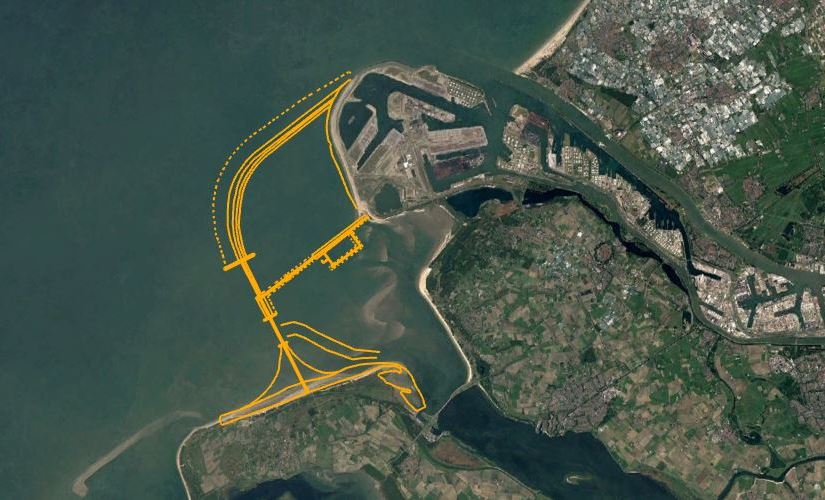
In an era of rising sea levels, ambitious plans for coastal protection works are emerging around the world. One such plan is the Delta21 project, proposed by group of Dutch coastal engineers and entrepreneurs. Their goal is to improve flood protection at the mouth of the Haringvliet estuary and develop a tidal power facility, all in one integrated project.

However, the law of unintended consequences often looms large in these sorts of massive infrastructure projects, particularly for environments as complex as estuaries. After a massive flood in 1953, the Dutch constructed the Delta Works, damming most of the estuaries in the southern half of the Netherlands. Prior to that, the Afsluitdijk was constructed across the Zuiderzee in the northern part of the country. These protection works have had dramatic consequences on the physical and ecological development of the Dutch coast, and many of my colleagues here have devoted their careers to analyzing the impact of these interventions.

But instead of just looking back and dissecting the successes and failures of 50 or 100 years past, what if we could also use our latest diagnostic tools for predicting the potential impact of bold future interventions? If the Delta21 plan goes ahead, how will the mouth and ebb-tidal delta of the Haringvliet estuary and surrounding coastline evolve? Will existing habitats (particularly in vital intertidal areas) be preserved, disappear, or even expand?

Today, Mayra Zaldivar Piña tackled these questions head on, and successfully defended her master’s thesis, “Stability of intertidal and subtidal areas after Delta21 plan“. I had the pleasure of co-supervising Mayra’s work throughout the last eight or so months, and am very proud of her. She embarked on a challenging modelling project and showed an exemplary critical scientific attitude. I was also so impressed with the persistence and tenacity she showed in doing nearly her entire project during the pandemic. Writing your thesis is a difficult and isolating experience at the best of times, and these are not the best of times. Nonetheless, she kept at it and delivered an impressive thesis in the end!

Congratulations Mayra, and best of luck in the next steps of your career!