Sediment Connectivity: Where does all the sand go?

I am thrilled beyond measure to announce that the first paper of my forthcoming PhD dissertation, Sediment Connectivity: A Framework for Analyzing Coastal Sediment Transport Pathways, has finally been published (open-access) in the Journal of Geophysical Research: Earth Surface!

What’s it about? As sand moves along coasts and through estuaries, the pathways it takes are determined by a complex combination of waves, tides, geology, and other environmental or human factors. These pathways are hard to analyze and predict using existing approaches, so we turn to the concept of connectivity.

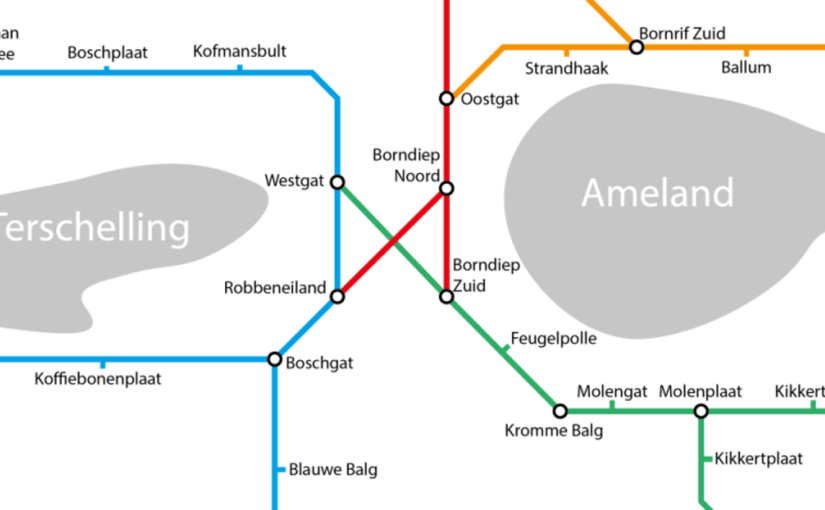
What is connectivity? Connectivity represents the pathways that sediment takes as a series of nodes and links, much like in a subway or metro map (see here for a primer). This approach is well used in other scientific fields like neurology, oceanography, and fluvial geomorphology, but in our study we apply these techniques to coastal sediment dynamics.

So what? To show how the sediment connectivity approach can be used in practice, we map sediment pathways with it at Ameland Inlet, an estuary in the Netherlands. The statistics we compute using connectivity let us quantify and visualize these sediment pathways, which tells us new things about the coastal system. We can also use this approach to answer practical engineering questions, such as where to place sand nourishments for coastal protection. We hope to use sediment connectivity to predict the response of our coasts to climate change, and the human adaptations that these changes provoke.

A conceptual summary of our paper on sediment connectivity at Ameland Inlet in the Netherlands. (a,c) We can schematize the sediment transport pathways in an estuary as a series of nodes (A,B,C,…) and the links connecting them. (b) This network can in turn be represented by a matrix, showing where the sediment is coming from (a source) and where it’s going to (a receptor). In this form, we can investigate questions like, “where does the sand in node F go?” (d), or “where does the sediment reaching node D come from?”(f). In my research, we are most interested in answering questions like, “what is the main pathway between the two islands, node A and G?” (e). We can also learn how the system is organized into “communities” that share sand (g), and how that changes when pathways are added or removed (h).

It has been a long journey, beginning with The Magical Figure that Changed My Entire PhD and now culminating in this publication. I am especially indebted to my supervisors, Bram van Prooijen and Zheng Bing Wang, for their constant support. I am also grateful to my other co-authors, Edwin Elias from Deltares and Sean Vitousek at USGS, for seeing potential in this approach and really strengthening and clarifying my story. I was also blessed with curious and constructive reviewers who provided a much-needed non-engineering perspective on our work.

Now that this paper is out, the fun can really begin! I have lots of fun ideas for applying connectivity to other estuaries around the world including the Mouth of the Columbia River and San Francisco Bay. We are also in the process of developing new modelling tools that well help us better unravel how estuaries and coasts are connected. Stay tuned!

Sources:

Pearson, S.G., van Prooijen, B.C., Elias, E.P.L, Vitousek, S., & Wang, Z.B. (2020). Sediment Connectivity: A Framework for Analyzing Coastal Sediment Transport Pathways. Journal of Geophysical Research: Earth Surface. [Link]

Do You Know the Way to San Jose? This Sediment Does…

What pathways does sediment take as it travels through an estuary?  Yesterday, Laurie van Gijzen defended her thesis, entitled “Sediment Pathways and Connectivity in San Francisco South Bay“. Laurie is one of the master’s students that I supervise, and she has done a great job on this project.

San Francisco Bay is a massive estuary, with over six million people living nearby.  In addition to San Francisco, Silicon Valley sits on its shores.  Some of the biggest tech companies in the world like Google and Facebook have their head offices right next to the Bay.  For over 150 years, the ecological health of the bay has deteriorated, in part due to land reclamations and contaminated sediment from gold mining. The dynamics of San Francisco thus have a huge economic, social, and environmental impact.

Laurie’s work focused on calibrating and improving a sediment transport model of the bay, in order to track the pathways of fine sediment (i.e., mud).  She worked with a notoriously fickle model (DELWAQ) and succeeded in greatly improving its calibration.

laurieSummary
Laurie’s thesis summarized into a single diagram (Figure 6.1 from her report).  She shows the dominant sediment pathways as dark arrows, and the net accumulation (import, in orange) or depletion (export, in blue).  Also indicated are the dominant physical processes responsible for sediment transport in the different parts of the bay.  The baroclinic processes mentioned here are currents resulting from density differences in seawater due to changes in salinity and temperature.

Another cool thing about her work is that Laurie was the first person to apply the coastal sediment connectivity framework that I have been developing!  She was able to use this to identify key transport pathways and critical locations in the bay. It was extremely helpful for my research, as it gives us a proof of concept that our framework is applicable to multiple sites and can tell us something useful.

Her work was also accepted for a presentation at the NCK Days conference, which was meant to be held this week in Den Helder, but was cancelled due to ongoing societal chaos. Great job, Laurie!