Fjords of the High Arctic

A few weeks ago, I was reading a book about glaciology recently when a sentence caught my eye.  Many advances in our understanding of how glaciers developed and transformed our world during the last ice age came from studying the Canadian landscape.  In particular:

A benchmark example [of paleo ice sheet reconstruction] was the compilation of the first Glacial Map of Canada in 1959, followed by its update in 1968, by the Geological Survey of Canada, based on painstaking aerial photograph and field mapping by its officers on a map sheet by map sheet basis after the completion of the aerial photograph coverage for the whole country in the 1950s.

This caught my eye, because I knew that my Grandpa on my Dad’s side of the family was a pilot who flew a lot of aerial surveys for the Canadian government in the late 50s.  I mentioned this to my Dad, just thinking he’d say, “gee, that’s cool”, and move on.  Apparently that triggered something in him though, because a few days later my email inbox was filled with a treasure trove of old family photos that I had never seen before.  In recent years I have also developed an interest in Arctic coastal geomorphology, so this discovery scratched a couple of itches for me.

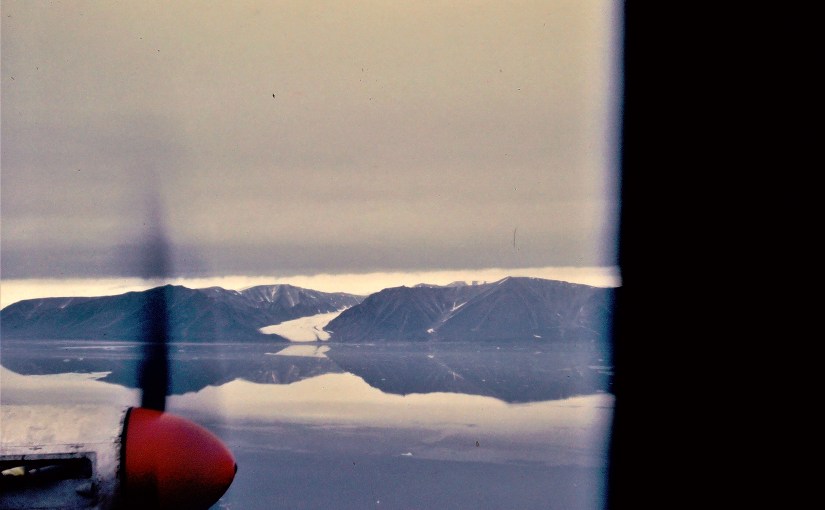
One of the photos was taken above Alexandra Fjord on Ellesmere Island, which is insanely far north (78°N!):

Wolverine CAMERA
Alexandra Fjord, Ellesmere Island.  Photo copyright B.G. Pearson.

The cool thing is that when I went into Google Earth, I was able to snoop around and actually to find the same vantage point.  To my surprise, it seems like the glaciers there haven’t changed much since my grandfather was there in 1957:

googleEarth
Alexandra Fjord today, seen in Google Earth.

However, Dad pointed out that perhaps the glacier at the front hasn’t changed, but that the ice field behind it has shrunk.  He probably has a point there…

Wolverine CAMERA
So pristine!  Photo copyright B.G. Pearson.
Wolverine CAMERA
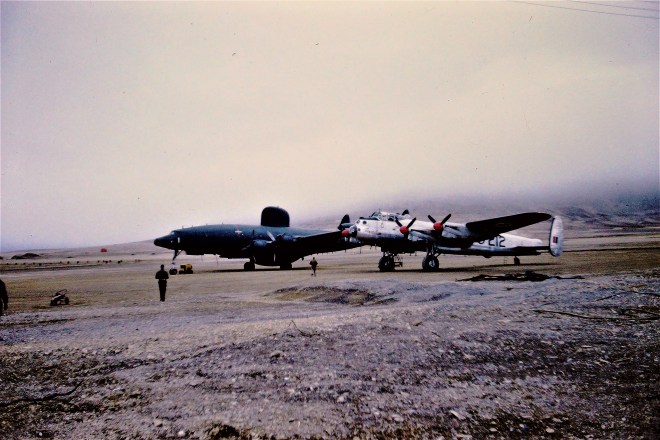
My Grandpa’s airplane on the right hand side.  Photo copyright B.G. Pearson.

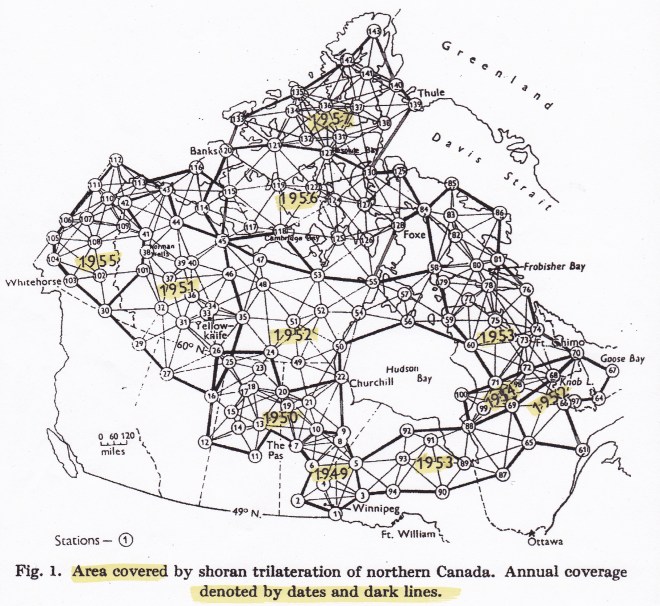
Why was he actually up there, and what were they surveying?  A series of radar transponders were set up across northern Canada so that the airplanes could precisely triangulate their positions .  Based out of Ottawa, my Grandpa and his colleagues carried out many long flights between remote destinations A newspaper article from 1957 describes the tremendous undertaking that mapping the entire Canadian Arctic was, apparently the world’s most ambitious aerial survey operation at the time:

SEVEN-YEAR JOB: Rockcliffe Squadron to Complete Mapping
Monday, March 25, 1957

“Planes from the RCAF’s 408 Photo Squadron at Rockcliffe Airport will fly to within 450 miles of the North Pole this Spring to complete the geodetic survey of Canada which it started seven years ago.”

“Using the huge USAF base at Thule, Greenland, and RCAF’s own base at Resolute Bay, both well within the Arctic Circle, the planes will criss-cross approximately 400,000 square miles of Arctic wasteland to produce reference points for the accurate mapping of Canada.”

“This year’s aerial mapping mileage will bring over 3,000,000 square miles – approximately 90 percent – of Canadian territory accurately surveyed by the Air Force. When the 300 men of the squadron return to base here about July 1, they will have completed the world’s greatest aerial survey operation.”
SHORAN.-Schematic-by-Year
Survey points in the Canadian Arctic from the 1950s.  My Grandpa flew some of the northernmost missions.

While the mapping operation may have been motivated by a Cold War-era push to map Canada’s north for defense purposes, the operation was also of great scientific benefit.  In addition to providing a wealth of useful data for glaciologists, the measurements also provided important insights into other fundamental geophysical questions.  For instance, the earth is not a sphere, but rather an oblate spheroid, or something like a squashed rugby ball.  But even then, gravity is weird and complicated, so the rugby ball comparison only takes you so far, and precise measurements are necessary to figure out all of the actual irregularities in Earth’s shape.

Measurements like these have many applications, including for estimating sea level rise rates.  By understanding how the Canadian Arctic is rebounding in response to deglaciation, scientists can better answer Tricky Questions About Sea Level Rise there.

One of my favourite stories from the 1957 article involved some of the corrections that were made to previous maps:

“Throughout the … programme, many positions believed to be accurate were found to be in error. In 1956, for example, Prince of Wales Island (in which the North Magnetic Pole was then located) was found to be three miles further south than was indicated on the map.”

“Although they didn’t possess any supernatural strength to move mountains, from such discoveries as this, the members of the 408 Photographic Squadron did, facetiously, claim the ability to move islands.”

I would thus like to think that all my research on islands is simply carrying on a Pearson family tradition!  My Dad (a civil engineer) also worked in the Arctic during the 1980s, constructing artificial islands in the Beaufort Sea.  That’s a story for another time, though!

Speaking of Pearson family traditions, I can see that my Grandpa also had a clear eye for photographic composition, a gift that my Dad quite strongly inherited:

Wolverine CAMERA
Airship on some remote runway in the far Canadian north.  Photo copyright B.G. Pearson.

Another reasons I was so delighted by these photos is because one of my favourite painters, Lawren Harris, also spent a lot of time in the Canadian Arctic. I have always felt drawn to his dramatic mountain landscapes capped with snow, and nary a tree for thousands of miles.  The mountains of the far north have a particular shape to them, which seems unique compared to most of the mountains I have seen with my own eyes.

mountThule
Mount Thule, Bylot Island, by Lawren Harris, one of my favourite painters.  He had a very unique view of the same Arctic landscapes my Grandpa used to fly over.

I made it as far north as Lofoten in Norway (68°N), and have flown over parts of the Arctic on transatlantic summer flights, but have never actually set foot on those rugged and remote hills.  Something for my bucket list!
sentinelAlexandraBay
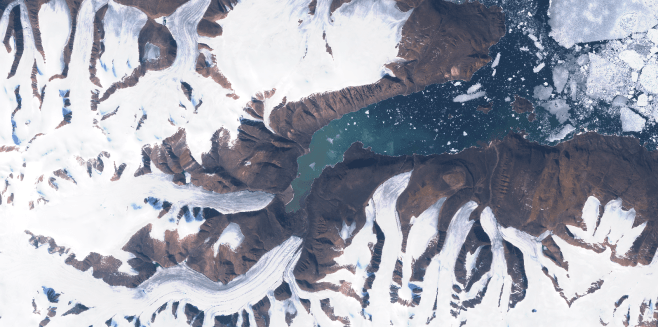
One more of Alexandra Fjord from space, because I can’t get enough of the staggering beauty of these landscapes.  [Source: Sentinel 2 L1C on July 17, 2019]

Coastally Curious and in Quarantine

Greetings from Delft on Day 10 of quarantine!  These are strange times indeed, on so many levels.  I am fortunately still safe and healthy at home in Delft.  Let’s all keep our hands washed and fingers crossed in the weeks to come, and STAY THE FRIG HOME! We’re all in this together.

I have in part been occupying myself with preparing online lectures for our Coastal Dynamics course. We are extremely fortunate in that most of the course was already available online due to preparations made in previous years, but the lectures I was meant to give this week on tidal inlets were not. I changed a bunch of things in the slides last year, so we had a number of student requests to record new lectures. We live in an era where online education was already becoming more and more the norm, and I think this crisis will just push that trend over the edge.

With that in mind, I decided to try my hand at narrating the slides using Kaltura, a program for doing video capture. There are a few different options out there, but that was the one that I liked best. I have actually been having a lot of fun with the lectures- it feels like I’m hosting a podcast or on the radio. “GOOOOOOOOOOOOOOOOOOOOOOOOOOOOOOD MORNING QUARANTINE!!!!!” I suspect it wouldn’t be the most popular podcast (there are not so many of us ebb-tidal delta enthusiasts), but hopefully I can convert a few of our students in the process.

On Friday I prepared a lecture on the evolution of barrier coasts, such as the Dutch coast or much of the Eastern and Gulf of Mexico coasts of the US. I couldn’t help but share a few interesting links with the students, and I thought I’d post them here too. This is a really cool animation showing 30 years of barrier island and tidal inlet evolution on the southeastern coast of Australia, obtained via satellite imagery:

There’s also the iCoast tool developed by the US Geological Survey for training their machine learning algorithms to recognize storm damage to barrier islands from hurricanes.  It shows you to see before and after photos, and asks you to tag the changes or damage that you see, which is a great way to learn more about coastal geomorphology.  You’re also helping the USGS improve their detection algorithms- citizen science!:
https://coastal.er.usgs.gov/icoast/

And here’s another cool interactive site about barrier islands that just popped up yesterday in my twitter feed:
https://wim.usgs.gov/geonarrative/ficc/

To keep myself sane/busy this weekend, I bought a linocut printing kit from the printing shop around the corner from my house (Indrukwekkend, which means “impressive” in Dutch- I love puns that work in more than one language!).  I had always wanted to try it out, but never made time for it.  No time like the present!    I took one of my old sketches of waves (see here for the original inspiration) and made a print of it.  By the end my desk was an unholy mess of ink, but I had a lot of fun and found the linoleum carving to be very therapeutic.  See the top of the page for the finished product!

10-linocut1

That’s all for now. Stay sane and healthy, readers!  And be kind to one another.

Do You Know the Way to San Jose? This Sediment Does…

What pathways does sediment take as it travels through an estuary?  Yesterday, Laurie van Gijzen defended her thesis, entitled “Sediment Pathways and Connectivity in San Francisco South Bay“. Laurie is one of the master’s students that I supervise, and she has done a great job on this project.

San Francisco Bay is a massive estuary, with over six million people living nearby.  In addition to San Francisco, Silicon Valley sits on its shores.  Some of the biggest tech companies in the world like Google and Facebook have their head offices right next to the Bay.  For over 150 years, the ecological health of the bay has deteriorated, in part due to land reclamations and contaminated sediment from gold mining. The dynamics of San Francisco thus have a huge economic, social, and environmental impact.

Laurie’s work focused on calibrating and improving a sediment transport model of the bay, in order to track the pathways of fine sediment (i.e., mud).  She worked with a notoriously fickle model (DELWAQ) and succeeded in greatly improving its calibration.

laurieSummary
Laurie’s thesis summarized into a single diagram (Figure 6.1 from her report).  She shows the dominant sediment pathways as dark arrows, and the net accumulation (import, in orange) or depletion (export, in blue).  Also indicated are the dominant physical processes responsible for sediment transport in the different parts of the bay.  The baroclinic processes mentioned here are currents resulting from density differences in seawater due to changes in salinity and temperature.

Another cool thing about her work is that Laurie was the first person to apply the coastal sediment connectivity framework that I have been developing!  She was able to use this to identify key transport pathways and critical locations in the bay. It was extremely helpful for my research, as it gives us a proof of concept that our framework is applicable to multiple sites and can tell us something useful.

Her work was also accepted for a presentation at the NCK Days conference, which was meant to be held this week in Den Helder, but was cancelled due to ongoing societal chaos. Great job, Laurie!

Sand: Clatsop Beach, Oregon

Today’s sand sample is from Clatsop Beach, Oregon, on the Pacific Northwest coast of the US.  Last summer I spent several months modelling sediment transport at the mouth of the Columbia River with the US Geological survey, and had the great privilege of making a site visit at the end of my stay.

Working in partnership with Oregon State University and the Washington State Department of Ecology, I assisted with a topographic survey of the beaches surrounding the Columbia.  Half the team surveyed the submerged parts of the beaches via jetski, and my group walked transects across the beach and up the dunes using backpack-mounted GPS units.

Starting at far-too-early-in-the-morning, our team split off individually, and I had an entire kilometers-long stretch of the beach to myself until almost lunch time, when we reconvened.  I love long walks on the beach and take great pleasure in that sort of solitude in nature, and it was even cooler to do that while collecting data that could help the project I was working on.  The digital computer model I had worked on all summer was now suddenly a real place where I could feel the sand between my toes.

Gold in Them Hills

The sand at this beach is interesting because of the black grains we see scattered throughout.  This sediment is made of minerals like chromite, magnetite, and garnet, which are heavier than the whitish quartz grains we see around them.  These deposits, known as “placers”, were transported to the sea from the mountains inland by the Columbia River. They form on the beach because lighter minerals like quartz are preferentially sifted out by waves and currents, leaving more of the dense particles behind.   This even includes trace amounts of gold!  Can you see any in the photograph below?

ClatsopBeachOR_000001
Sediment sample from Clatsop Beach, OR.  Note the black “placer” deposits of heavy minerals.  Can you see any flecks of gold?

At the end of our survey, I walked along the beach to check out a surprising object emerging from the sand: the wreck of the Peter Iredale, a sailing ship that ran aground there in 1906:

petereyerdale
The Wreck of the Peter Iredale on Clatsop Beach.

Known as the “Graveyard of the Pacific“, the mouth of the Columbia is truly a “killer ebb-tidal delta”: huge waves and powerful currents meet violently, and have caused dozens of shipwrecks over the past few centuries.  This makes effective management of the sediment there crucial for safe navigation, keeping the shipping channel dredged clear and disposing of the sediment in environmentally-friendly, cost-effective, and useful ways.

wrecks
Historical shipwrecks at the Mouth of the Columbia River, seen in the Columbia River Maritime Museum.  

Strategic placement of this dredged sediment was the focus of my time at USGS last summer, but I will delve into that more in a future post!

Sand: UBC Cliffs/Wreck Beach

Vancouver holds a special place in my heart.  I was born out there, and even though we moved away when I was very young, it has continued to re-emerge in my life.  In 2011, I moved out there after a difficult breakup and the city breathed new life back into me.  While there, I discovered a new vocation in hydraulic modelling for predicting floods, something that I am still doing to this day.  I have returned to Vancouver a number of times since then, since my brother and a surprising number of my closest friends have ended up out there.  I hope to return this September for a wedding!

vancouver
Coal Harbour, Vancouver.

One of my favourite parts of Vancouver is walking its coastline.  The city was built on the edge of a large fjord, but has a variety of coastal landscapes, from towering cliffs to sandy beaches, mud flats to salt marshes, and of course a number of urbanized shorelines.

Even though I am in the Netherlands now, I am trying to keep my Vancouver connection alive through my work.  Last year, I co-supervised a fantastic group of TU Delft students who worked with Kerr Wood Leidal and the University of British Columbia (UBC) to investigate the erosion of the Point Grey cliffs, on which UBC is situated.

wreckbeach3
Eroding cliffs of Point Grey.  The University of British Columbia is at the top of the cliff, so naturally they are concerned with understanding the rate of erosion and means of slowing it.

The project was an interesting one, as the students (representing three different countries) tried to bring their lessons learned about Dutch coastal engineering to Canada.  Canadian coastal zone management is much more fragmented than in the Netherlands, where everything is more or less centrally controlled by the federal government.  The entire Dutch coastline is also incredibly well-monitored, with high resolution bathymetry taken every few years, and with countless other measurements available.  Acquiring the data necessary to perform a coastal engineering study in Vancouver required contacting dozens of different sources and dealing with numerous agencies at multiple levels of government.

UBCcliffs_000012
Sand from Wreck Beach.  It is quite coarse and angular in shape, and the green and red tints are quite nice. Being glacial in origin, these sand grains have likely been bulldozed by ice or carried by meltwater from far and wide.  This accounts for the variety of particles we see.

In the end, the students looked at a number of possible solutions for slowing the coastal retreat, including sand nourishments and revetments.  One of the most intriguing concepts that they explored was the idea of a clam garden, a traditional approach from the First Nations people living on the BC coastline.   Originally intended for aquaculture, clam gardens are usually small rock walls placed along gravel beaches, behind which where clam-friendly sand or mud can accumulate.  However, this approach could have added benefits for coastal protection by attenuating waves and encouraging the deposition of sediment.  In many ways, it is not that different from the Dutch using brushwood dams to reclaim land in the Netherlands or my colleagues using similar structures to rebuild mangrove habitats.

In Canada, the involvement of First Nations in coastal planning is becoming increasingly important (as I think it should be!), and there is a lot that science and engineering can benefit from their traditional forms of knowledge and experience.  Building with nature instead of fighting against it has recently become a popular design philosophy in coastal engineering, and who better to have as allies in that task than the people who have been living with and building with nature already for centuries?

wreckbeach2
World War II-era bunker on Wreck Beach overlooking the Georgia Strait, with North Vancouver in the background.


The Delft-Vancouver connection continues: right now we have a group of five students investigating coastal protection solutions with Kerr Wood Leidal and the Tsleil-Waututh Nation.  They have already been out there for a month, and I am excited to see what they come up with!

spanishBanks
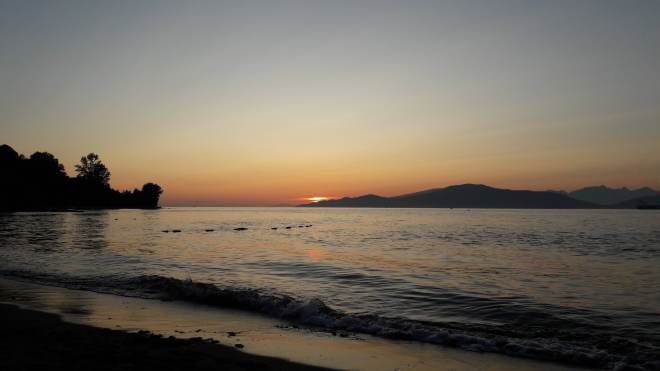
Sunset over the Spanish Banks, just around the corner from UBC.

Tricky Questions About Sea Level Rise

Last week in our Coastal Dynamics course, we discussed the topic of sea level rise (SLR) and its impact on coastlines around the world.  A rather perceptive student asked me about an assignment question about the subtleties of regional sea level rise:

Where in the world does the melting of the Antarctic Ice Sheet have the greatest impact?

This is a good question, because it shines a light on the complex reality of sea level rise: it is not the same everywhere.  Local factors like isostatic adjustment and regional subsidence mean that certain locations can deviate significantly from the global average rate of sea level change.

Isostatic adjustment is the flexing of the earth’s crust as it rebounds from the heavy weight of ice sheets that once pressed down on it (much like the behaviour of your couch cushions after you stand up). This means that some formerly-glaciated areas like Northern Canada and Norway actually experience a local sea level fall, not a rise.  Further away from those glaciated areas, you can have the opposite effect and experience increased sea level rise due to a sort of levering effect.

However, another important principle (and a mind-blowing one to me, when I first heard it), is that of gravitational attraction: ice sheets are so massive that they actually exert a gravitational pull on the oceans, pulling water levels up towards them.  The flipside of this is that when those ice caps melt, the water near them redistributes to the other parts of the oceans further away.  This leads to the remarkable notion that us in the northern hemisphere will suffer most from the melting of Antarctica, while our southern cousins will get their feet wet primarily from the deglaciation of Greenland and mountainous ice caps in the northern hemisphere.

slr_fingerprinting
Contribution to sea level rise from Greenland (top panel) and the West Antarctic Ice Sheet (bottom panel).  In general, the further away from the ice sheet, the greater the increase in sea level (orange colours).  Source: Milne, et al. (2009). Identifying the causes of sea-level changeNature Geoscience2(7), 471-478.

There has recently been some interesting research on the idea of “fingerprinting” the impact of a particular glacier on sea level rise at a given location through exploratory modelling:

“The loss of mass changes Earth’s gravitational field causing the fresh meltwater and ocean water to move away towards faraway coastlines; the resulting pattern of sea-level rise is the fingerprint of melting from that particular ice sheet or glacier. For example, the latest study found that ice melt in Antarctica causes sea level to rise 52% faster in California and Florida than it does in other parts of the world, Velicogna says. Much of Earth’s middle and lower latitudes bear the brunt of rising sea levels because they’re sandwiched between Antarctica and Greenland, which are home to massive ice sheets that are shedding mass as meltwater or icebergs.” Source.

This article in the Guardian nicely illustrates the relevant concepts.  See also here and here for more details.  From these sources (and the references therein) we can see that the mechanisms contributing to sea level rise are highly location-dependent, and I barely skim the surface here.  Although these questions of “which glacier is submerging my house?” are scientifically fascinating, it shines some light on just how complicated our planet’s climate system really is.  It is scary to wonder about all of the future impacts like these that we can’t foresee or don’t yet understand…

The Beach: A River of Sand

It’s February, which means it’s Coastal Dynamics season again!  5 years ago (time flies!), I  first arrived in the Netherlands as part of my master’s program.  I walked into the classroom for Judith Bosboom’s Coastal Dynamics 1 course, and it really changed everything for me.  CD1 felt like the course I had been waiting for all my life, combining geology, geography, physics, and practical engineering all in one package.  The course was also so well-taught and structured that it seemed like an IV drip of knowledge, pulsing straight to your brain.  I felt like I was truly in the right place and coastal engineering was the field for me.  It cranked my enthusiasm for all things coastal to 11.

After I became a PhD student, I began TAing the course and learned what it was like on the other side of the classroom.  This revealed a hitherto unsuspected enthusiasm for teaching (although perhaps it shouldn’t have been a big surprise, given that I come from a large family of teachers), and has been a big factor in my interest to stay in academia.

Every year, we start the course by showing students the video “River of Sand”, which explains coastal sediment transport in an easily understandable way.  This video is 55 years old now, but it still does a better job of explaining how beaches work than almost anything else I’ve seen.  I hope you enjoy it as much as we do!

Ungava Bay: Giving the Bay of Fundy a Run for its Money

Growing up in Canada, we were always taught that the Bay of Fundy, is home to the world’s highest tides. The difference between the highest high tides and lowest low tides is 17.0 m, plus or minus 0.2 m [Arbic et al., 2007].  When I was younger (long before I ever knew that coastal engineering was a career option), I had the good fortune of visiting the Bay several times, usually while en route to visiting my Mom’s family in eastern Canada.

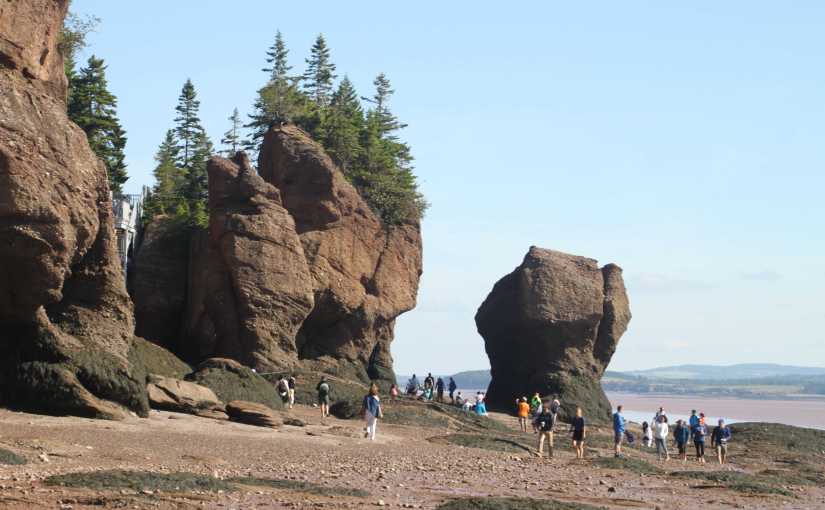
When the tide retreats, tidal flats stretch for tens of kilometers, making you question which direction the ocean is actually in.  The Hopewell Rocks (pictured above) are revealed, and tourists wander the base of beautiful red cliffs.  Then right on schedule, the tide returns, and everything is bathed deep in chocolate milk for 6 hours.

mudflats
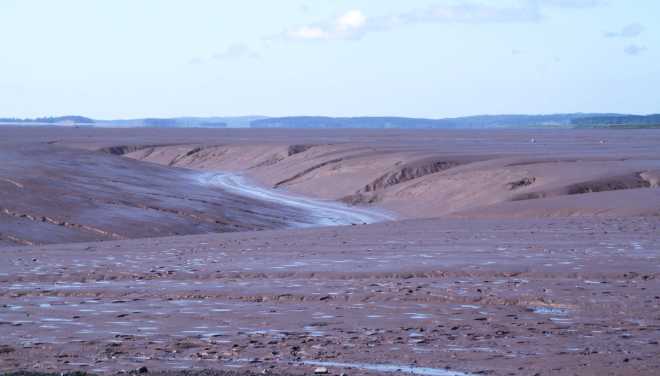
Massive tidal gullies on the mudflats of the Bay of Fundy, near the Hopewell Rocks. Photo: Stuart Pearson.

However, 1600 km due north of Fundy lies Ungava Bay, which is also fighting for first place in the World’s Highest Tides Competition.  Flanking Hudson Strait (which connects Hudson Bay to the Atlantic Ocean), Ungava Bay has a maximum tidal range of 16.8 m, plus or minus 0.2 m [Arbic et al., 2007].  This means that the difference between the Bay of Fundy and Ungava Bay is so small that it is within the limits of what we can measure- the jury is still out!

How do the tides grow so large in these bays?  The answer is resonance.  Tides generated by the gravitational pull of the moon rise and fall every 12.4 hours (one tidal period).  By coincidence, the time it takes a tidal wave (i.e. one full cycle of low water to high water and back to low water) to travel the length of Ungava Bay is 12.7 hours [Arbic et al., 2007].  This means that a new tidal wave is coming into the bay just as the old one is coming out.   If you push a child on a swing, they will travel much higher if you properly time your pushes with the rhythm of their swinging.  The same holds true with tides moving in and out of a bay, and we call this phenomenon resonance.

The speed at which a tidal wave travels depends on the depth of the water, the shape and size of the bay or estuary it moves through, and friction from the seabed.  The consequence of this is that changes like sea level rise and the construction of tidal power stations or storm surge barriers can actually modify the behaviour of the tides.  For instance, an increase in sea level rise could bring Ungava Bay even closer to that 12.4 hour resonant period, and further increase the tidal range there [Arbic et al., 2007].  However, this would require 7 m of mean sea level rise to increase the tidal range by just 2%, which I think would be a much bigger problem…

Usually friction from the seabed is one of the main factors that affects tidal waves in estuaries, dissipating energy and damping out their range.  However, a recent study by my TU Delft colleagues Kleptsova & Pietrzak [2018] found that friction at the surface of the water from sea ice can also have a moderating effect on tidal amplitude.  As a consequence, the tidal range in the far-north Ungava Bay actually decreases during the winter. This suggests to me that Fundy remains the World Champion at Christmas, but that during the summer, it’s still anybody’s guess.

An interesting question (and the one that sparked my curiosity to write this post in the first place) then becomes: how might our tides change in a world where the Arctic no longer fully freezes over?  To me, this is just one more example of the scary Pandora’s Box that humanity has opened with rapid climate change.  If something as seemingly dependable as the tides can change, what other surprises will nature have in store for us?

Sources:

Arbic, B. K., St‐Laurent, P., Sutherland, G., & Garrett, C. (2007). On the resonance and influence of the tides in Ungava Bay and Hudson StraitGeophysical Research Letters34(17).

Guo, L., Wu, Y., Hannah, C. G., Petrie, B., Greenberg, D., & Niu, H. (2020). A modelling study of the ice-free tidal dynamics in the Canadian Arctic ArchipelagoEstuarine, Coastal and Shelf Science, 106617.

Kleptsova, O., & Pietrzak, J. D. (2018). High resolution tidal model of Canadian Arctic Archipelago, Baffin and Hudson BayOcean Modelling128, 15-47.

Singing Sand: Cannon Beach, Oregon

This week we have some sand from Cannon Beach, Oregon, which is most famous for this big, beautiful rock:

CannonBeach
Haystack Rock on Cannon Beach, Oregon.

Located on the Oregon coast just south of the Columbia River mouth, I passed through Cannon Beach last summer on my drive to Vancouver.

The most peculiar thing about this sand was that it squeaked when I walked on it. You read that correctly- it made a squeaky noise when you stepped in it, which was a delightful surprise.  I had heard about this phenomenon before, but never experienced it myself.  “God, that’s weird!” says one Youtuber after running their hands through the sand at Cannon Beach:

This “singing sand”, is due to localized shear: as you step into the sand, it causes the grains to rub past one another and generate sound [Humphries, 1966].  This tends to happen if the sand grains are well-sorted (all more or less the same size) and highly spherical [Lindsay et al., 1976].  In the photograph below, the sand grains don’t look particularly spherical, but they are indeed quite consistent in size (just compare with one of the more poorly-sorted samples we looked at in previous weeks).

CannonBeachOregon_000001
Squeaky sand from Cannon Beach, Oregon.

However, sand does not always sound so cute: it can also make apocalyptic booming noises“Booming sands” have been documented before in sand dunes, sounding like the world’s most enormous and terrifying swarm of bees. The sound seems to depend on the grain size and the layer of sand that is avalanching down the slope[Vriend et al., 2007], although there is still some debate about the actual mechanism.  

Something to think about the next time you hear a strange noise at the beach or in the desert!

Sources

Andreotti, B., Bonneau, L., & Clément, E. (2008). Comment on ‘‘Solving the mystery of booming sand dunes’’by Nathalie M. Vriend et al. Geophys. Res. Lett35, L08306.

Humphries, D. W. (1966). The booming sand of Korizo, Sahara, and the squeaking sand of Gower, S. Wales: a comparison of the fundamental characteristics of two musical sandsSedimentology6(2), 135-152.

Lindsay, J. F., Criswell, D. R., Criswell, T. L., & Criswell, B. S. (1976). Sound-producing dune and beach sandsGeological Society of America Bulletin87(3), 463-473.

Vriend, N. M., Hunt, M. L., Clayton, R. W., Brennen, C. E., Brantley, K. S., & Ruiz‐Angulo, A. (2007). Solving the mystery of booming sand dunesGeophysical research letters34(16).

Ice: Strait of Belle Isle

Last week, the Newfoundland (on the east coast of Canada) got hit by a record-breaking storm: a “hurricane blizzard”, with 150 km/h winds, >10 m waves, and almost a metre of snow.  Newfoundlanders are no strangers to bad weather, but this is rough stuff even by their standards.

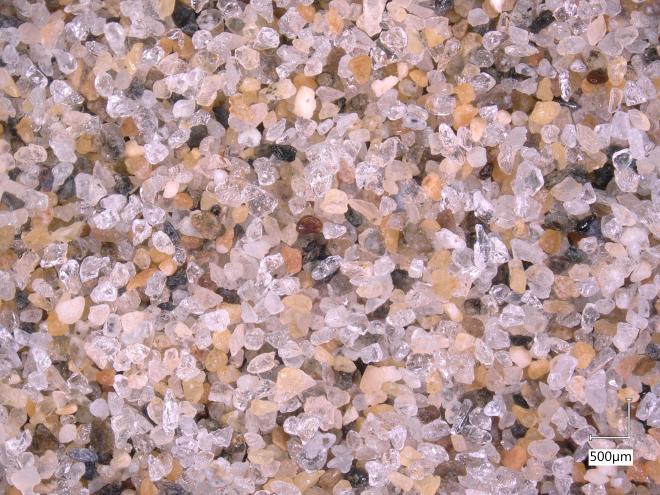
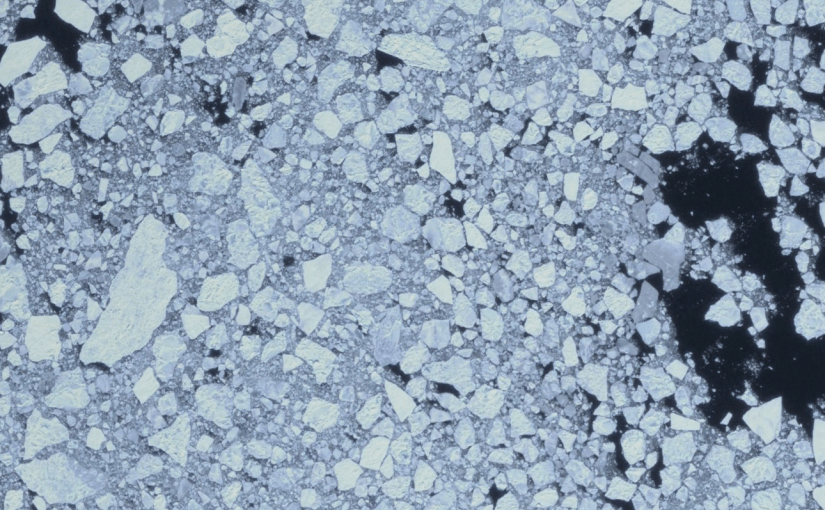
In a fit of procrastination, I started wandering around Newfoundland in Google Earth. The Strait of Belle Isle separates the northern tip of Newfoundland from the rest of Canada, and is often frozen over in the winter.  When this ice breaks up in the spring, it makes beautiful patterns from space.  What struck me was that the broken ice floes looked a lot like the microscopic sand photographs I have been posting on this website:

seaice
Ice floes in the Strait of Belle Isle, Newfoundland on April 22, 2015.  For scale, the big floe on the left is 150 m across its longest axis.
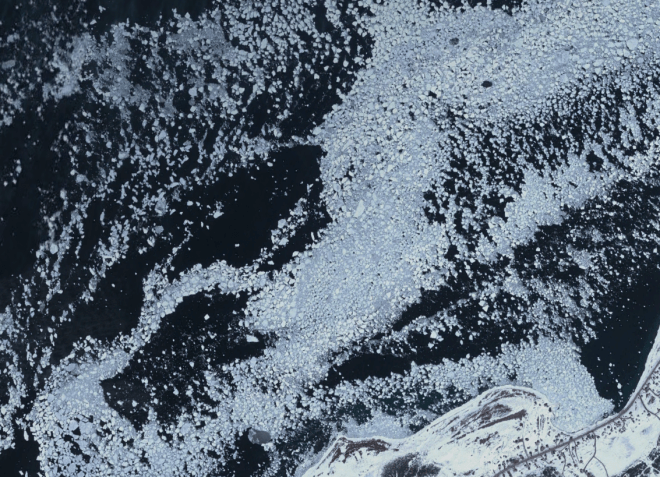
seaice2
When you zoom out a bit further you can start to see larger patterns that appear to be formed by different flows shearing past one another.  For scale, look at the 150 m-long floe in the middle (which we saw in the previous photo).

Apparently the shape and size of sea ice floes is largely governed by ice melting, collisions and mergers between floes, and breakup due to flexing by ocean swell waves (Toyota et al., 2006).  Even though the specifics of the mechanisms moving and shaping sand grains on the seabed at millimetre scales are different from those acting on ice floes one million times larger, the same general laws of physics still apply.  This is one of my favourite things about nature: there is great beauty in finding similar patterns at different scales in completely different contexts!

Sources:

Toyota, T., Takatsuji, S., & Nakayama, M. (2006). Characteristics of sea ice floe size distribution in the seasonal ice zoneGeophysical research letters33(2).