Veni!

Large populations near the sea are vulnerable to coastal floods, making coastal safety and sustainability an urgent societal priority. This is especially true in the Netherlands, where over a quarter of the country lies below sea level, and the main protection from deadly coastal floods is a barrier of wide, high sandy beaches and dunes. However, this sandy buffer is constantly moving and chronically eroding. To plan effective future coastal adaptations, we need to know where that sand is coming from, going to, and which paths it takes to get there. I am delighted to share that I have just received a Veni grant from the Dutch Research Council (NWO) to investigate this!

Where is the sand on beaches going, and how does it get there?

My overarching goal is to enable effective sediment-based climate adaptation strategies for vulnerable coasts. To approach this, I consider coasts as an interconnected network of sediment pathways, like a subway map showing how stations are linked. This connectivity reveals the hidden structure underlying chaotic sediment pathways through coastal systems. These pathways are immensely difficult to identify on real coasts due to the challenge of tracking individual sand grains from multiple sources in such a dynamic environment.
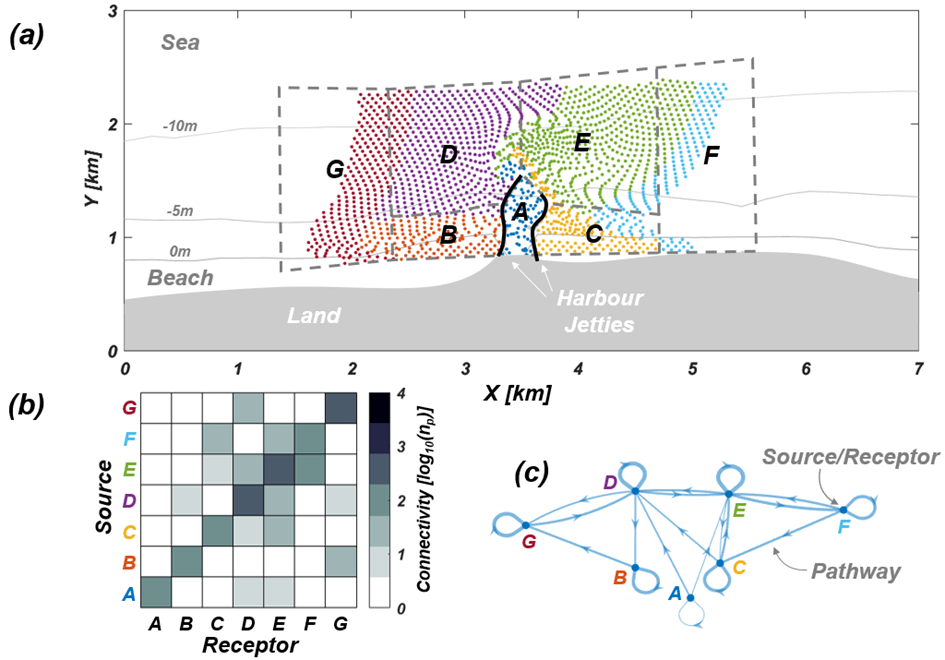
Proof-of-concept connectivity analysis of a beach and harbour.
(a) Map of tracer particles in example SedTRAILS model from 7 different source patches at a snapshot in time. (b) The number of particles (np) from a given source in each receptor is counted to yield a connectivity matrix, graphically represented by a connectivity network diagram (c).

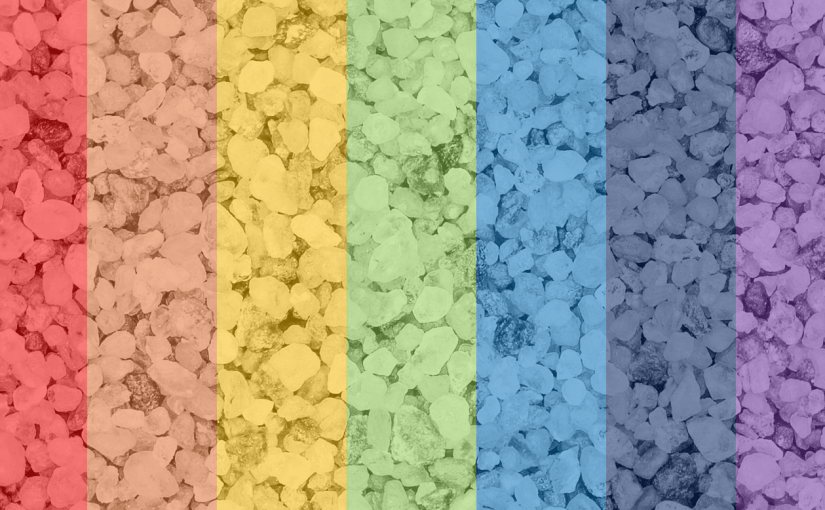
To deal with this challenge, this grant will enable me to develop both a scale model in a physical laboratory and a numerical model in a digital laboratory. In a wave tank the size of an Olympic swimming pool, I will construct a beach from multi-coloured sand. As waves disperse the sand, the resulting rainbow of sediment will reveal their pathways, which I will then quantify as a network in the digital laboratory. The resulting open datasets and numerical models will serve as a benchmark for the coastal research community, generating new theories and improved tools. My collaborators in the Netherlands, US, and New Zealand will help me to implement these findings in research, engineering practice, and coastal management policy. In this way I hope to enable more effective management of sediment for coastal adaptation and a more holistic understanding of our coastal systems.

Stay tuned for more updates once the project begins!

Of Shells & Sand

Have you ever walked along a windy beach and noticed shells sitting atop small peaks of sand, like a miniature mountain range? Does a shell “protect” the sand underneath, or does the sand pile up behind it? Does the shell actually cause more erosion around it? How does a shell affect the way sand moves along beaches? What happens when you have millions of shells along a beach? Does that affect the way the beach as a whole erodes? Now what about the parts of a beach that we can’t see, below the water?

Shells emerging from the beach on little pedestals of sand

These might seem like the thoughts of an idle beachgoer, but are actually essential to helping us understand how to sustainably protect our coasts. As part of the TRAILS project, Tjitske Kooistra is investigating how sand nourishments influence sensitive ecosystems on the Dutch coast. In order to do that, we need to understand how shells and sand interact at the bottom of the sea, since there are many locations along the Dutch coast where shells make up a significant portion of the beach material. This is really difficult to understand in the field, so to figure this out in a more controlled setting, Tjitske planned a series of lab experiments and we recruited Steven Haarbosch to carry them out.

After months of hard work shovelling sand and crunching numbers, Steven successfully defended his thesis, “The influence of bivalve shells of different shapes and sizes on current-driven sediment transport“! He conducted excellent, tremendously useful research, and I am really proud of what he accomplished.

Continue reading Of Shells & Sand

The Cappuccino Effect

Do you ever think about the swirling patterns in your cappuccino as you stir your spoon around, the brown coffee folding in past the white foam? And do you ever think about sediment transport as you do it? Just me? Ok, never mind…

I had the great privilege of hanging out in New Orleans this past week, being a sand nerd with four hundred of my fellow sand nerds at the Coastal Sediments conference. In between jazz sets at the Spotted Cat, we shared our latest ideas about coastal dynamics, built new collaborations, and rekindled old pre-pandemic friendships. My contribution this year was an attempt to bring the science behind cappuccino coffee swirls to coastal sediment transport.

Continue reading The Cappuccino Effect

Of Sediment and Seedlings

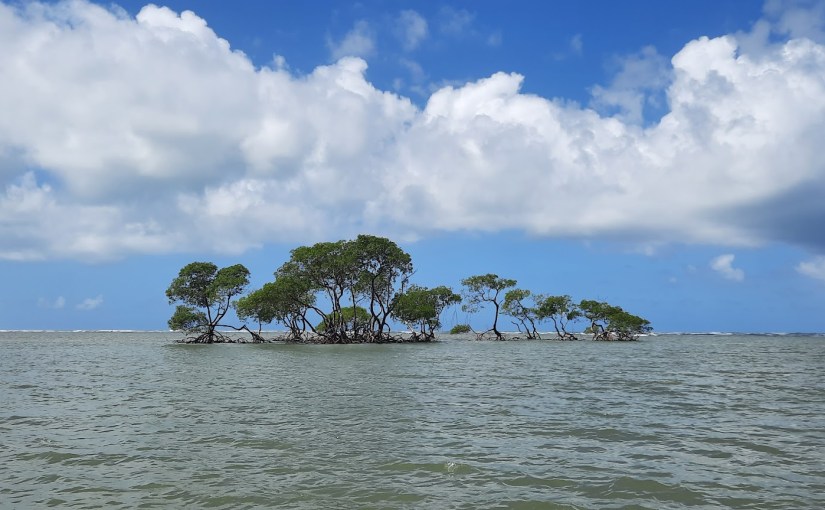
Mangrove forests protect tropical coastlines around the world from the effects of waves, in addition to providing valuable habitat for countless species. As such, their preservation and restoration is a key element of many plans for improving coastal resilience against flooding and erosion in the face of climate change. However, you can’t *just plant* a mangrove forest anywhere – mangroves are extremely picky, dancing on the edge of the intertidal zone where they get just wet enough but never too wet for too long. They also need safe, stable shorelines for their seedlings to take root and grow stronger, without too many waves and with just the right sort of muddy conditions to make a comfortable home.

Mangroves drop their seeds (called propagules) in the water, which then float around with the currents for days to weeks until they find a suitable home. But which pathways do these mangrove seedlings take as they float along the coast? Are those the same pathways that sand and mud take? These are questions that we need to answer in order to make better decisions about mangrove restoration. To get to the bottom of this, we recruited Femke Bisschop.

Last Friday, Femke successfully defended her thesis, “Modelling sediment and propagule pathways to improve mangrove rehabilitation: A case study of the pilot project in Demak, Indonesia“. She developed a numerical model of a site in Indonesia to simulate the motion of rivers and tides there, and then used the SedTRAILS model to visualize and interpret the pathways of sediment and mangrove propagules.

Continue reading Of Sediment and Seedlings

Tracking Sand that Hides from the Sun

Keeping Dutch feet dry is mainly done by placing piles of sand along the coast as “nourishments”. These nourishments build out the beaches and dunes to act as a protective buffer against storms. However, as was recently pointed out by an official at Rijkswaterstaat, the Dutch water ministry, the Hamvraag or “bacon question” is still “where the heck does all that sand actually go?”

Knowing where nourished sand goes is important for understanding the ecological impact of nourishments, as well as their effectiveness. If you want your sand to reach a certain destination, how much of it actually gets there and how quickly?

Continue reading Tracking Sand that Hides from the Sun

Sediment Pathways on Ebb-Tidal Deltas

After 5 years of blood, sweat, and tears, I present to you my PhD thesis: Sediment Pathways on Ebb-Tidal Deltas: New Tools and Techniques for Analysis! I will defend my PhD on March 8th.

How do sand and mud move around on our coasts?  This is a question that we need to answer in order to sustainably manage coastlines in the face of sea level rise and climate change. To do so, we use a combination of field measurements and computer simulations at Ameland Inlet in the Netherlands. In the course of my PhD we developed several new methods, including morphodynamic mapping techniques, a sediment composition index (SCI) derived from optical and acoustic measurements, techniques for sediment tracing, the sediment connectivity framework, and a Lagrangian sediment transport model (SedTRAILS). Together, these approaches reveal new knowledge about our coasts which can be used for managing these complex natural systems.

That’s a bit of a mouthful, so let’s break it down and try to explain what I have been doing with sand for the last half-decade…

Continue reading Sediment Pathways on Ebb-Tidal Deltas

Sediment Pathways in Vancouver

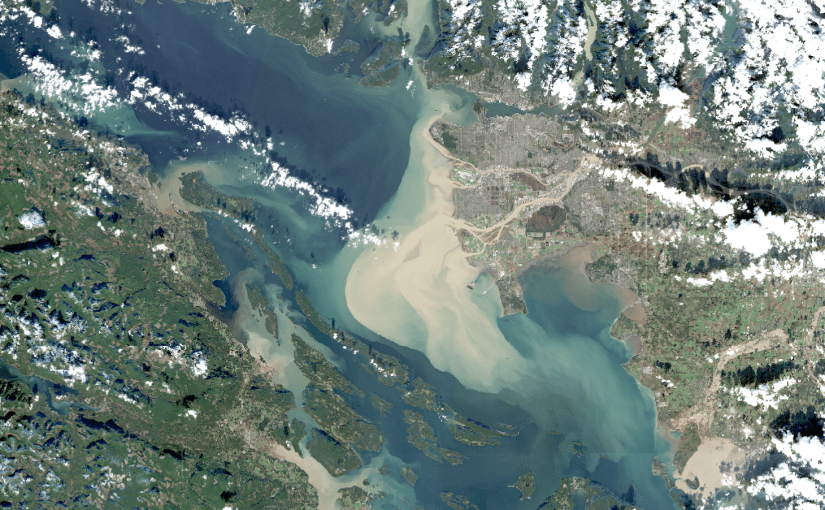
In the past few weeks, Vancouver and the BC Lower Mainland have suffered not just one but three record-breaking rainstorms, a succession of ”atmospheric rivers” that dumped several hundred millimetres of rain. Highways washed out and disappeared, and numerous communities were flooded. This resulted in an enormous quantity of sediment reaching the sea via the Fraser and other local rivers. But where exactly does the sediment that’s already in the sea around Vancouver go? How has that changed in the past few hundred years since Europeans colonized the area? To get to the bottom of this, we enlisted Carlijn Meijers.

Last week, Carlijn successfully defended her thesis, ”Sediment transport pathways in Burrard Inlet”. To answer these questions, she created a detailed hydrodynamic and sediment transport model of Burrard Inlet and Georgia Strait in D-Flow FM. She then used the SedTRAILS model that we have developed to visualize sediment transport pathways.

Modelled sediment transport pathways in Burrard Inlet. The red arrows highlight key patterns in the SedTRAILS particle trajectories. Burrard inlet is characterized by strong flows through the narrowest points of the fjord, and large eddies in the wider areas. Source: Meijers (2021).

From these models, Carlijn showed that sediment transport is largely controlled by flow through the First and Second Narrows (where the Lion’s Gate and Ironworker’s Memorial bridges cross). As the tide comes in, the water shoots through these narrow passages at speeds of up to 2 m/s and comes out the far side as a jet, spiraling off into eddies. The tide then goes out and the same happens in reverse, with water shooting out the opposite side.

Conceptual diagram showing the dominant sediment pathways in the Inner Harbour. Source: Meijers (2021).

Due to the sheltered nature of the inlet, waves have only a minor role in sediment transport. However, given the intensity of the tides and the great depths of Burrard Inlet (especially the Indian Arm fjord to the north), most sediment liberated by erosion tends to get carried away from shore and is essentially lost from the coastal sediment budget.

Another key point of her project was to investigate how land use changes and other human effects (e.g., damming rivers, port construction) have changed Burrard Inlet. Using the model, Carlijn showed that these changes to the inlet have shrunken its tidal prism, influencing the currents and sediment transport patterns.

Comparison of the present-day shoreline with the high and low tide lines from 1792, prior to colonization by European settlers. The Second Narrows are so narrow because they were formed by the delta of Seymour River and Lynn Creek. The area has since been dredged and walled off for the construction of the port and to create log booming grounds. Source: Meijers (2021).

These changes are especially evident when we compare satellite photos from the present day with the oldest available images from the 1940s.

Second Narrows in the 1940s and 2021. Please forgive my crappy georeferencing, I eyeballed it. Source: City of Vancouver and Google Earth.

Carlijn wrote an excellent report and capped it all off with one of the best master’s thesis defenses that I’ve seen in a long while. She also handled the cultural context of the project with great respect, interest, and sensitivity.  If anyone reading this is looking to recruit a new engineer/researcher with heaps of potential, I cannot recommend Carlijn enough.

All in all, this was a fascinating project and one very close to my heart — I was born in the Vancouver area and was excited to see how the SedTRAILS model could be used in my original backyard. Let’s keep the Delft-Vancouver collaborations going!

Predicting the Unpredictable

Ebb-tidal deltas are notoriously unpredictable. Battered about by waves and tides, their ever-shifting sands can be a royal pain in the arse for everyone from coastal residents to pirates. I have spent most of the past five years trying to identify the pathways that sand takes across these deltas as part of my PhD. However, the holy grail of ebb-tidal delta research is to take that one step further and make accurate morphodynamic predictions of their evolution on timescales of decades.

This past year, Denzel Harlequin took up the challenge, and I am pleased as punch to announce that last week he successfully defended his master’s thesis, ”Morphodynamic Modelling of the Ameland Ebb-Tidal Delta”. This is a really tricky problem to solve because of the complexity of the processes that need to be simulated.

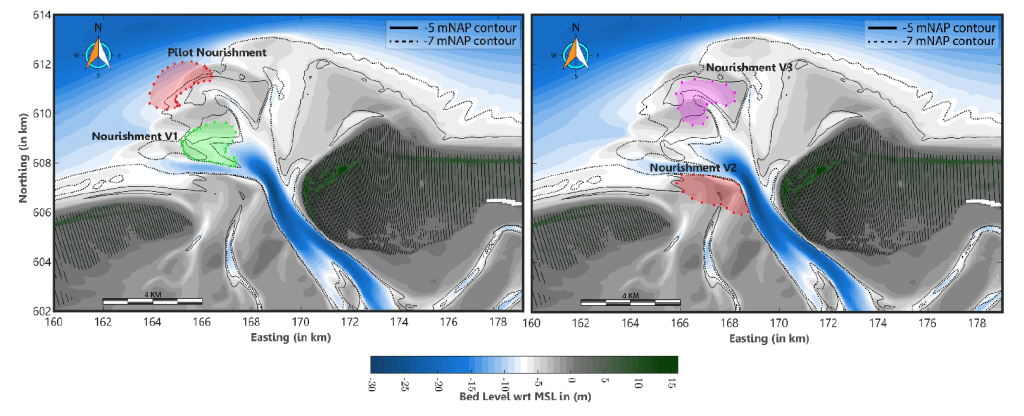
What’s cool about Denzel’s work is that brings us closer to good morphodynamic predictions than we were before. Furthermore, where the predictions deviate from reality, he illuminates the areas where we still need to make improvements — specifically, our representation of wave-driven transports. Denzel also shows how the location of a sand nourishment can have major knock-on effects on the evolution of the ebb-tidal delta.

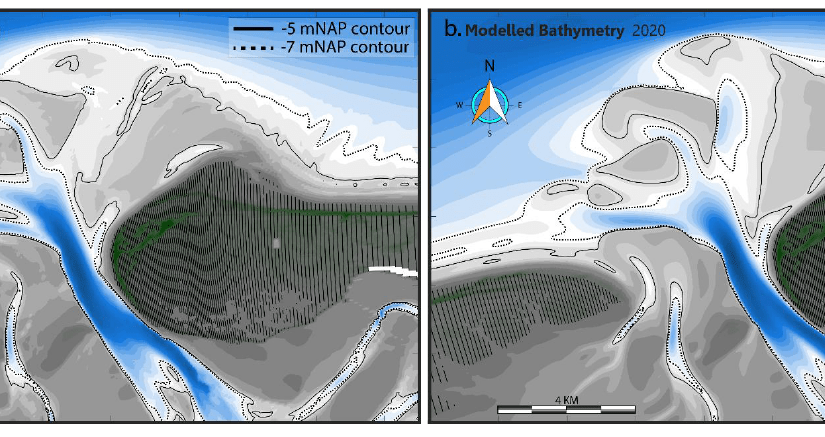
Different nourishment designs tested by Denzel. If you place the sand in a more dynamic area like a channel, it can have a much wider effect on the rest of the ebb-tidal delta.

Denzel is a very talented modeller and I am delighted that he has joined us as a new colleague in the Applied Morphodynamics department at Deltares. I look forward to many more great collaborations to come!

Blowing in the Wind

We forgave Bagnold everything for the way he wrote about dunes. “The grooves and the corrugated sand resemble the hollow of the roof of a dog’s mouth.” That was the real Bagnold, a man who would put his inquiring hand into the jaws of a dog.
– Michael Ondaatje, The English Patient

Ralph Bagnold, widely considered one of the godfathers of sediment transport, was a soldier in the British army who spent much of the Second World War scouting around in the Libyan desert. In the process, he learned much about the dynamics of sand dunes, and formed the basis for many theories that are still in use today for explaining how sediment is blown around by wind or water.

This week I am proud of our very own up-and-coming Bagnold, Charlotte Uphues, who successfully defended her thesis, Coastal Aeolian Sediment Transport in an Active Bed Surface Layer, on Thursday. Charlotte did a fantastic job of designing and carrying out her own super cool field experiments, using tracer sediment to estimate aeolian (wind-blown) sediment transport on a beach here in Holland. As the dunes of the Netherlands are a key component to Dutch coastal defenses against flooding, it is essential that we understand better how they evolve by improving our abilities to predict aeolian transport.

I would elaborate a bit more about her findings, but Charlotte will be submitting her thesis for publication in a journal soon, so it will remain under wraps for now. Stay tuned, I don’t think we’ve heard the last from Charlotte!

Sediment Pathway Detective Work

Ebb-tidal deltas are gigantic piles of sand that form at the seaward mouth of tidal inlets. They are constantly on the move, shifting shape and size in response to the waves and tides. Where exactly is that sand going? This is a question I have been struggling with for the past 5 years during my PhD, and we have recently made great strides in part due to the efforts of Paula Lambregts.

Yesterday, Paula Lambregts successfully defended her master’s thesis, “Sediment bypassing at Ameland inlet“. I had the great honour of co-supervising Paula’s research throughout the last ten or so months, and I am enormously proud of her. Her project encompassed a range of approaches, including bathymetric analysis and numerical modelling, to solve the mystery of the sediment pathways.

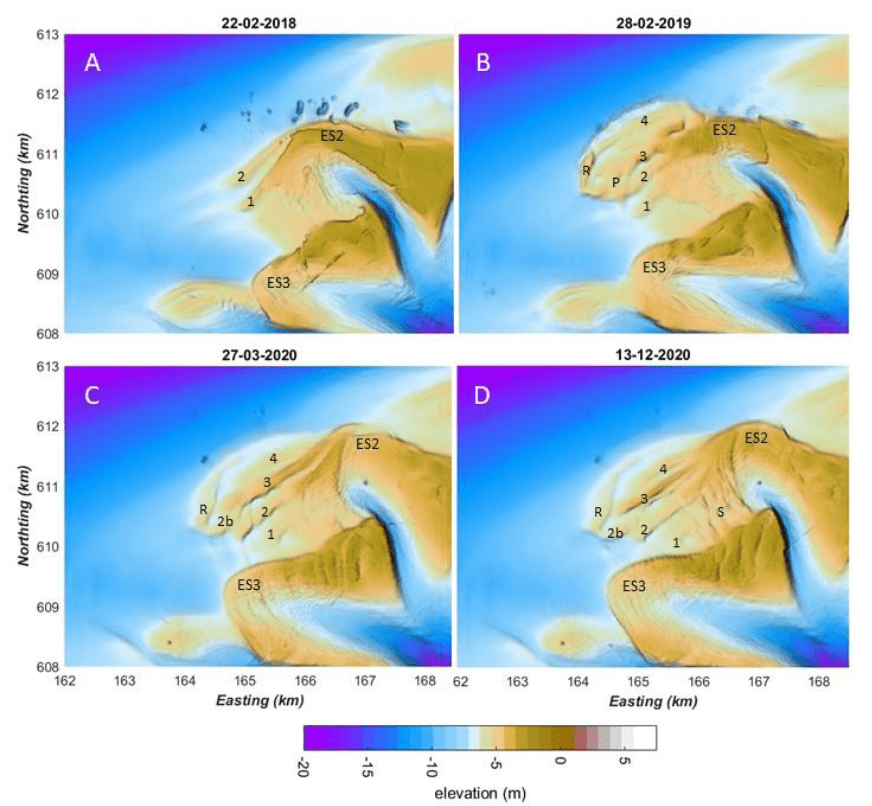
First, Paula’s detective work led her to examine detailed measurements of the seabed bathymetry at Ameland Inlet in the Netherlands, taken over the past fifteen years. These measurements give snapshots of the underwater delta landscape. By comparing the bathymetry from different months or years, we can track the delta’s evolution. In the image below, we see four snapshots of the ebb-tidal delta before and after the construction of a sand nourishment (i.e., the large pile of sand that appears in panel B). This nourishment was a large-scale pilot test to determine if creating sand deposits like this is a viable strategy for strengthening the coast of nearby islands.

Bathymetric maps showing Ameland Ebb-Tidal Delta before (A) and after (B,C,D) the construction of a massive sand nourishment. Paula’s analysis tracked how this nourishment evolved over time, smoothed and smeared out to the east and south east by the combined effects of waves and tides.

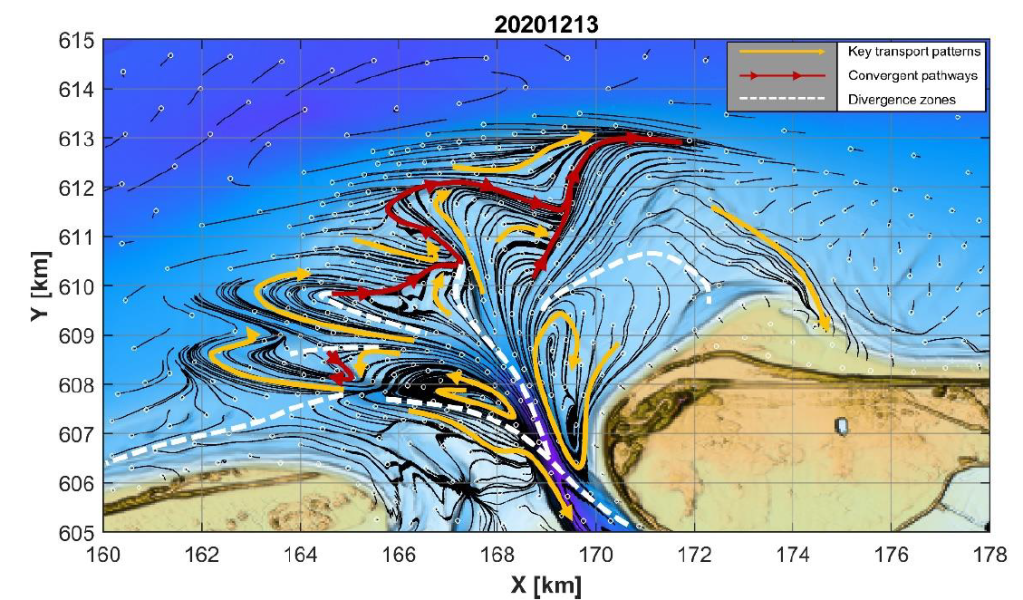
After describing how the delta has evolved in the past, Paula developed hypotheses about the physics underlying this behaviour- how do waves and tides move the sand around to create the patterns we observe? To answer this question, she used a combination of computer models to estimate sand transport pathways. This allows us to “connect the dots” and explain how the sand moved from one place to another. The first component was a D-Flow FM model, which is used to simulate the hydrodynamics (waves and tides) and sediment transport (where and how much sand moves). The second component of her modelling approach was to apply SedTRAILS, a brand-new tool developed by my colleagues and I at Deltares for visualizing predicting sediment transport pathways. Using SedTRAILS, she was able to create some really cool maps that indicate where the sand goes.

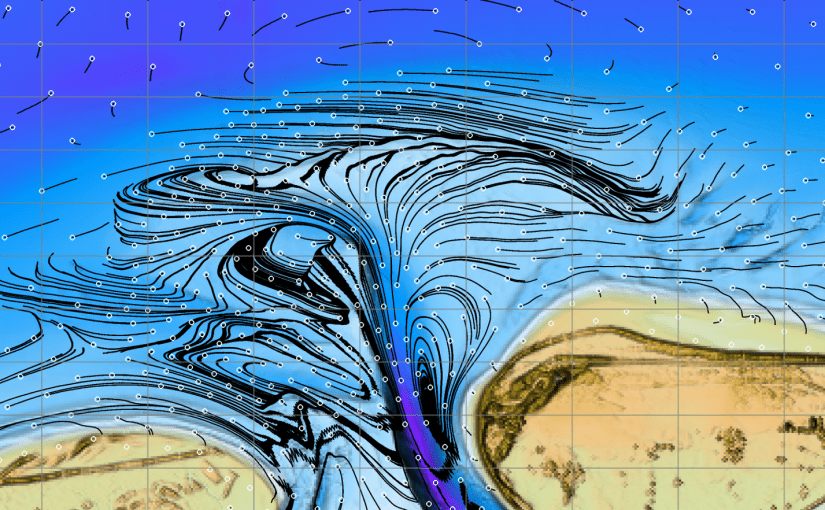
Sediment transport pathways on Ameland ebb-tidal delta in 2020, as visualized using SedTRAILS. The small white circles indicate the source locations of sediment, and thin black lines show the sediment pathways originating from those sources. The yellow lines highlight major transport pathways, and the red lines indicate convergent zones where multiple pathways meet. The white dashed lines indicate divergence zones, where the transport pathways veer away from and (on average) do not cross.

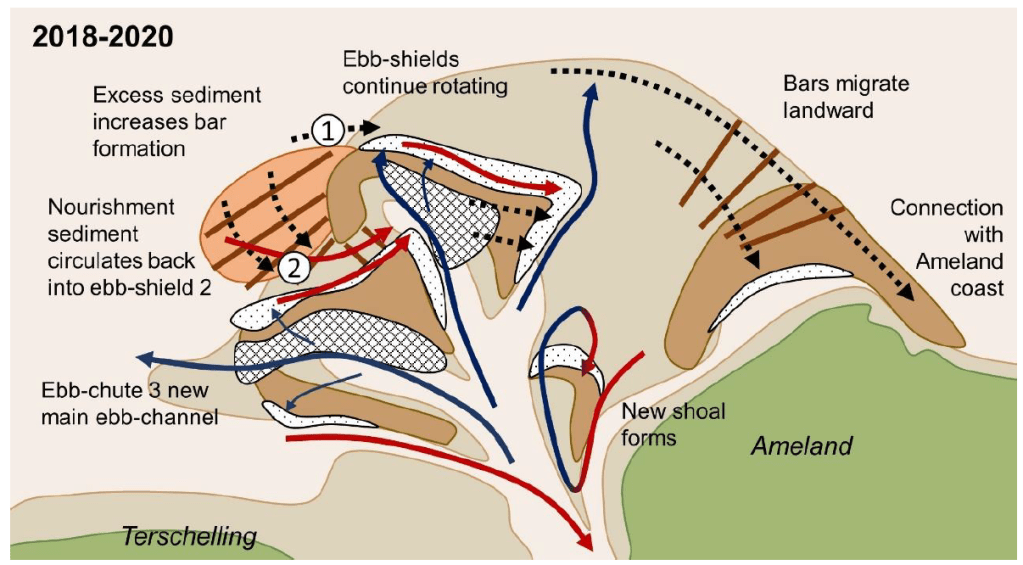
Drawing on her prior expertise in geology, Paula combined those two lines of evidence (the measurements of the seabed and the modelled sediment pathways), to come up with a series of fantastic conceptual diagrams. These diagrams distill the mysterious piles of sand and complex spaghetti of the images above into a more easily understandable picture:

Paula’s conceptual model summarizing all of the different processes shaping Ameland ebb-tidal delta in 2020. Check out her thesis to see the complete evolution over the past 15 years!

The work that she did is extremely valuable for coastal management, since it gives more insight into where (and where not!) to construct sand nourishments. It also brings new insights to science about how these complex systems work. Last of all, it is enormously helpful for the research that we are continuing to do at TU Delft and Deltares. In September I will continue on with the work on sediment transport pathways at tidal inlets begun during my PhD, and build on the work that Paula has carried out in her thesis project. I am extremely proud of her and hope that we can continue to collaborate in the future!